
Hybrids are having their best year yet in Malaysia. According to the latest road transport department (JPJ) data, 5,448 hybrid vehicles were registered in September 2026, up 9.8% from August’s 4,964 and more than double the 2,399 recorded in September 2025. That is 7.3% of all new registrations in the month, up from 3.8% a year earlier.
It also takes the year-to-date (YTD) total to 40,181 units, 83.1% more than in the first nine months of 2025 (21,944) and already well past the previous full-year record of 31,190, set last year. June (5,646) and July (5,622) 2026 are the two best months for hybrids on record, with September third.
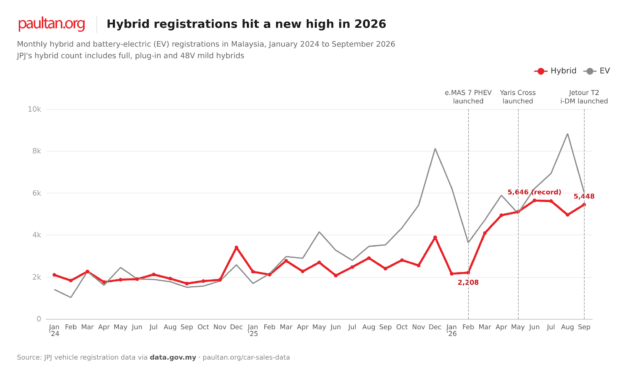
The jump came early this year. Hybrid registrations mostly ran between 2,000 and 3,000 units a month through 2024 and 2025, then climbed past 4,000 in March and have stayed above 4,900 every month since April. Behind it was a string of launches: the Toyota Vios Hybrid at the end of January, the Proton e.MAS 7 PHEV in February, the Nissan Serena e-Power in March and the Toyota Yaris Cross in May. Hybrids even outsold EVs in May (5,103 against 5,038), the first time that has happened since January 2025.
A note on what counts as a hybrid here. JPJ’s data puts three different technologies under the same fuel type: full hybrids that charge themselves, such as Toyota’s hybrids and Honda’s e:HEV models; plug-in hybrids (PHEVs), which can be charged from a socket and run on electric power alone for longer distances; and 48-volt mild hybrids, where a small electric motor assists the petrol engine but cannot drive the car on its own. We have labelled each model in the table below by type. Some models are sold in more than one hybrid form, such as the Mercedes-Benz C200 (mild hybrid) and C350e (plug-in hybrid), or the parallel-imported Toyota Crown, which comes as both a full hybrid and a plug-in hybrid. As JPJ’s data doesn’t say which version was registered, we have marked these models “mild or plug-in” or “full or plug-in”.
By our count, full hybrids made up 59% of this year’s hybrid registrations (23,868 units) and models sold only as plug-in hybrids another 29% (11,758). That plug-in figure was just 653, or 3%, in the first nine months of 2025. Mild hybrids, and models offered in more than one hybrid form, account for the remaining 11% or so.
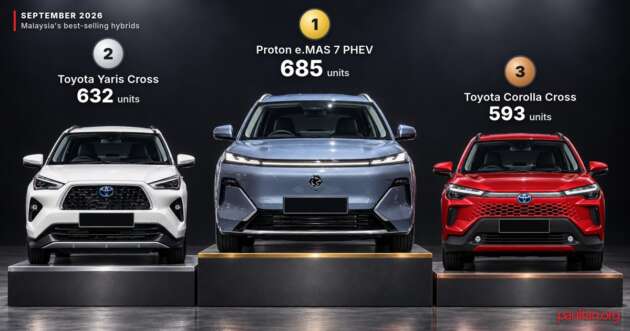
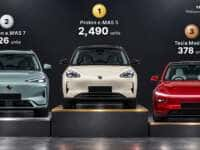
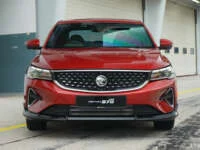
The Proton e.MAS 7 PHEV is back at the top in September with 685 units, up 11% from August, after the Toyota Yaris Cross briefly took the lead in August. The plug-in SUV, launched as Malaysia’s cheapest PHEV, topped the hybrid chart every month from March to July and is the best-selling hybrid of 2026 so far with 6,247 units. That is more than the all-electric e.MAS 7 has managed in the same period (4,530), and more than half of the 11,758 units registered by plug-in-only models this year.
Toyota fills the next three places. The Yaris Cross is second with 632 units (down 13%), and the hybrid accounts for half of all Yaris Cross registrations since the SUV went on sale in May (3,190 of 6,411). The Toyota Corolla Cross is third with 593 units (4,723 YTD), with the hybrid making up 55% of its sales this year, and the Vios is fourth with 521, up 8%. As a brand, Toyota registered 1,855 hybrids in September, 34% of the total.
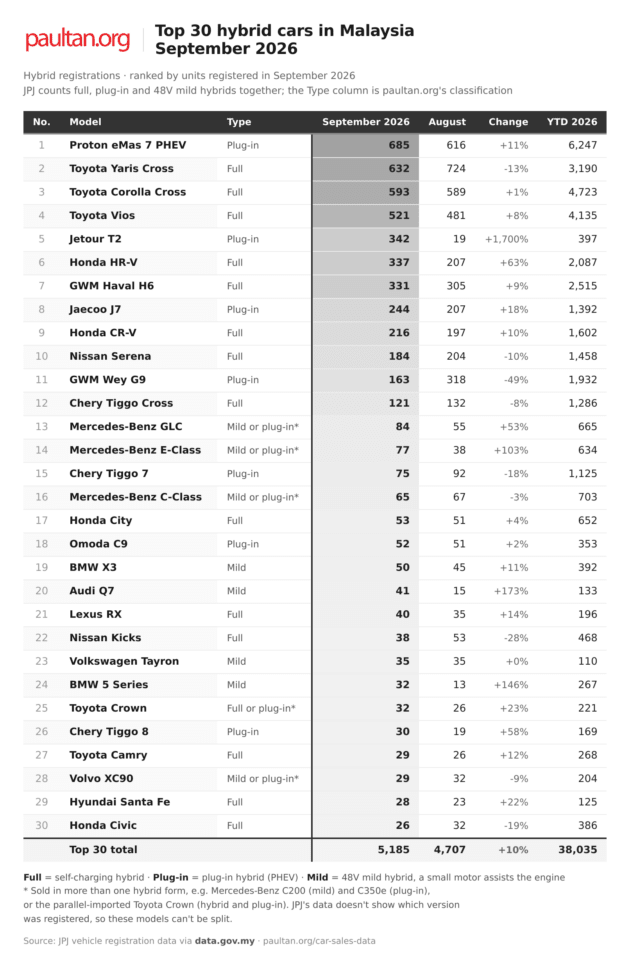
The Jetour T2 is the big mover, jumping to fifth with 342 units after the T2 i-DM plug-in hybrid was launched on September 19. The PHEV was on sale for only the last 12 days of the month, and it had collected 2,137 bookings before it was launched. The Honda HR-V is sixth with 337 units (up 63%), followed by the GWM Haval H6 in seventh (331), the Jaecoo J7 in eighth (244, up 18%), the Honda CR-V in ninth (216) and the Nissan Serena in tenth (184).
The GWM Wey G9 drops to 11th with 163 units, down 49% from August, ahead of the Chery Tiggo Cross in 12th (121). Mercedes-Benz has three models in the top 20: the GLC in 13th (84), the E-Class in 14th (77) and the C-Class in 16th (65), with the Chery Tiggo 7 in 15th (75). Completing the top 20 are the Honda City (53), Omoda C9 (52), BMW X3 (50) and Audi Q7 (41).
Rounding out the top 30 are the Lexus RX (40 units), Nissan Kicks (38), Volkswagen Tayron (35), BMW 5 Series (32), Toyota Crown (32), Chery Tiggo 8 (30), Toyota Camry (29), Volvo XC90 (29), Hyundai Santa Fe (28) and Honda Civic (26). In all, 68 different models were registered as hybrids in September.
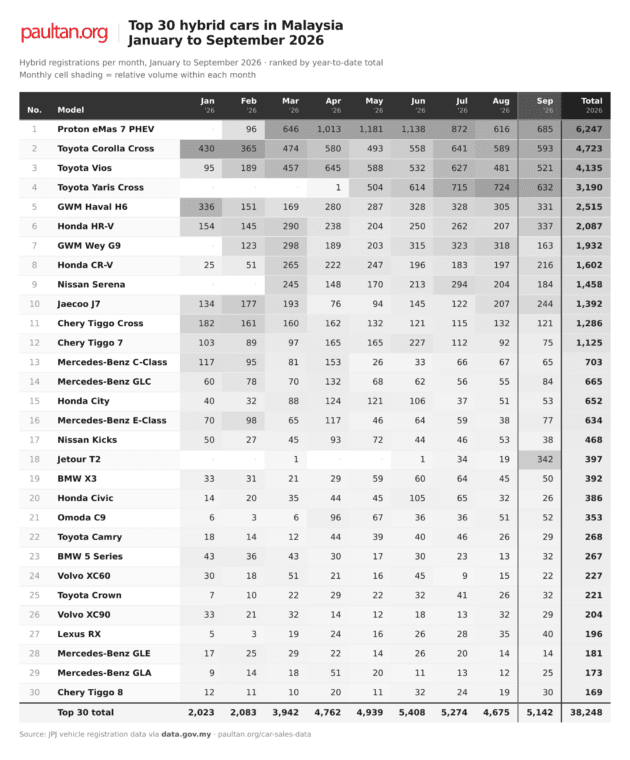
Year to date, the e.MAS 7 PHEV (6,247) leads the Corolla Cross (4,723), Vios (4,135), Yaris Cross (3,190) and Haval H6 (2,515). Toyota is by far the biggest hybrid brand with 12,849 registrations, 32% of the total, while Chinese brands such as Chery, GWM, Jetour and Omoda | Jaecoo together account for 23%.
Add September’s 6,029 EVs and electrified vehicles made up 15.5% of the 74,259 new vehicles registered in the month. EVs still outsell hybrids in most months, but the gap is closing: so far this year, 53,537 EVs have been registered against 40,181 hybrids.
Want to dig deeper? Our car sales data tool lets you explore and analyse Malaysian new-vehicle registrations in detail, from monthly and yearly trends for every make and model to rankings by brand, body type and fuel, plus dedicated views for the EV market and the national carmakers, all built on the same JPJ data behind this story and updated every month.





Going by what ‘certain people’ were saying, I thought Japanese cars were totally done for.wwww
EMas7 PH.EV 215hp 258Nm combined with 8.0s to 100km/h also make luxury Genting drive. It has got the inner beauty, strength and comfort. More powerful and more convenient with V2L too.
Congratulations to Proton and Toyota.
This is driving the dream for Saga Cross X30 Hybrid next.