

Previewed earlier this month, the 2026 Honda City facelift is now on sale in Malaysia, with the car making its official debut earlier this morning. The 2026 iteration is the second facelift for the fifth-gen sedan, which arrived here in October 2020 before it was replaced by the first facelift in August 2023.
Three years on, the latest update – which was unveiled in India back in May before making its Southeast Asian debut in Thailand a month later – arrives here, introducing a new face and some minor cosmetic changes to the exterior as well as a few upgrades to the interior. Before we get to the changes, let’s take a look at the available variants and their pricing.
The current line-up largely follows that for the first facelift, save one exclusion. Similar to the downscaling taken with other Honda models, the base Grade S variant has been dropped for this new cycle, which means the City sedan range now consists of four variants, in this case three petrol versions (E, V and RS) and a sole hybrid option, the e:HEV RS.

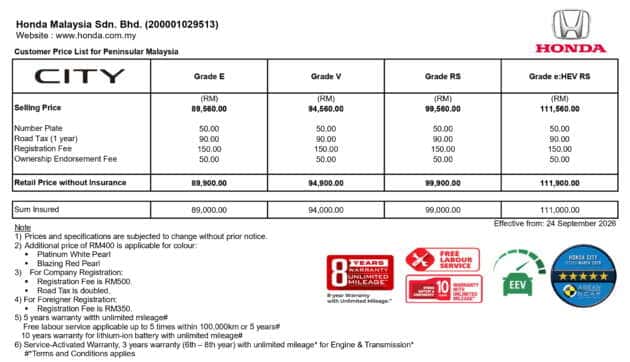
The 2026 Honda City facelift range is priced at (all on-the-road, without insurance):
- City 1.5L E – RM89,900
- City 1.5L V – RM94,900
- City 1.5L RS – RM99,900
- City 1.5L e:HEV RS – RM111,900
The prices are identical to the previous City facelift, except that the previous RM84,900 S is no longer available, pushing the entry price up to that of the E. At the launch, HMSB announced that the first 2,400 City buyers will enjoy a RM3,000 rebate, applicable to all variants.
As it with all Honda models sold in Malaysia from September 1, the City facelift now comes with an eight-year, unlimited-mileage warranty, with the e:HEV getting an additional 10-year hybrid component warranty.


Save for a change in length brought about by the front and rear end revisions, the exterior dimensions of the car are unchanged. The non-RS versions of the 2026 City stretch the tape at 4,577 mm long, three mm shorter than previously, while the new RS measures in at 4,594 mm, five mm longer than the 2023 version. Width remains at 1,748 mm and height at 1,467 mm. Likewise, boot space, which is 519 litres on the petrol versions and 410 litre on the e:HEV.
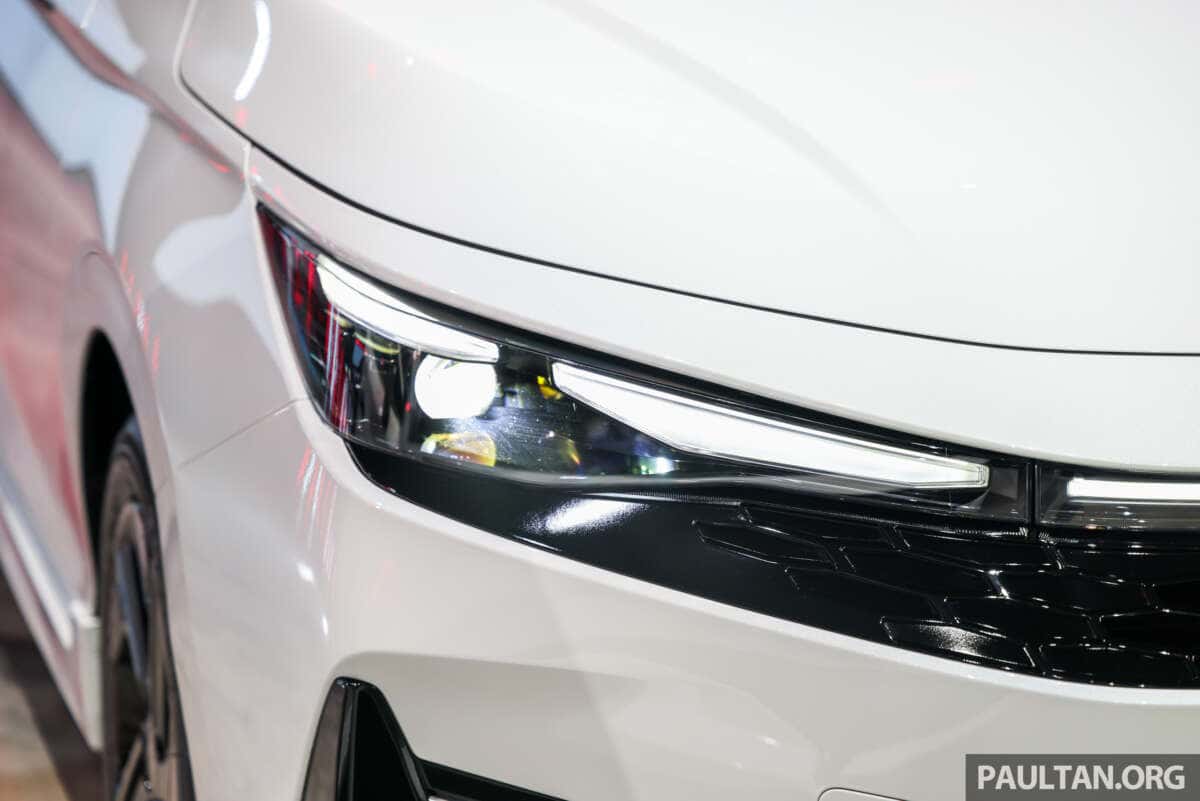
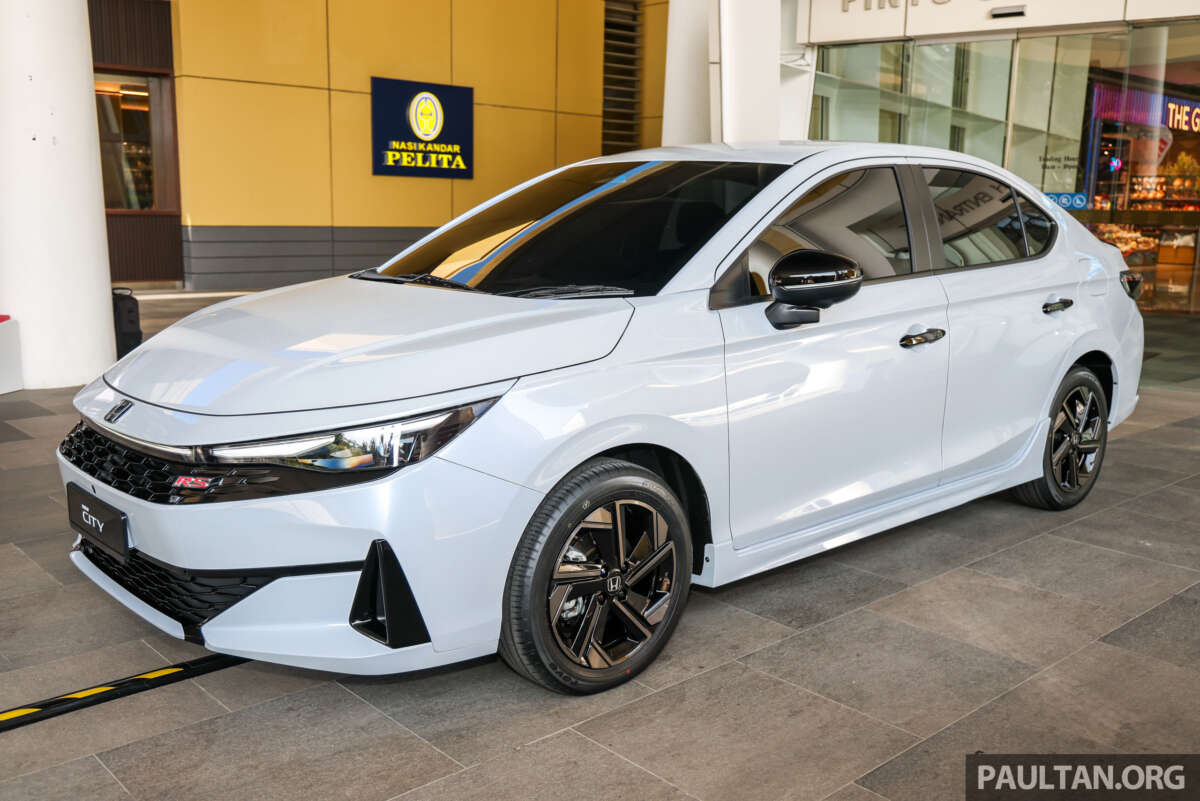
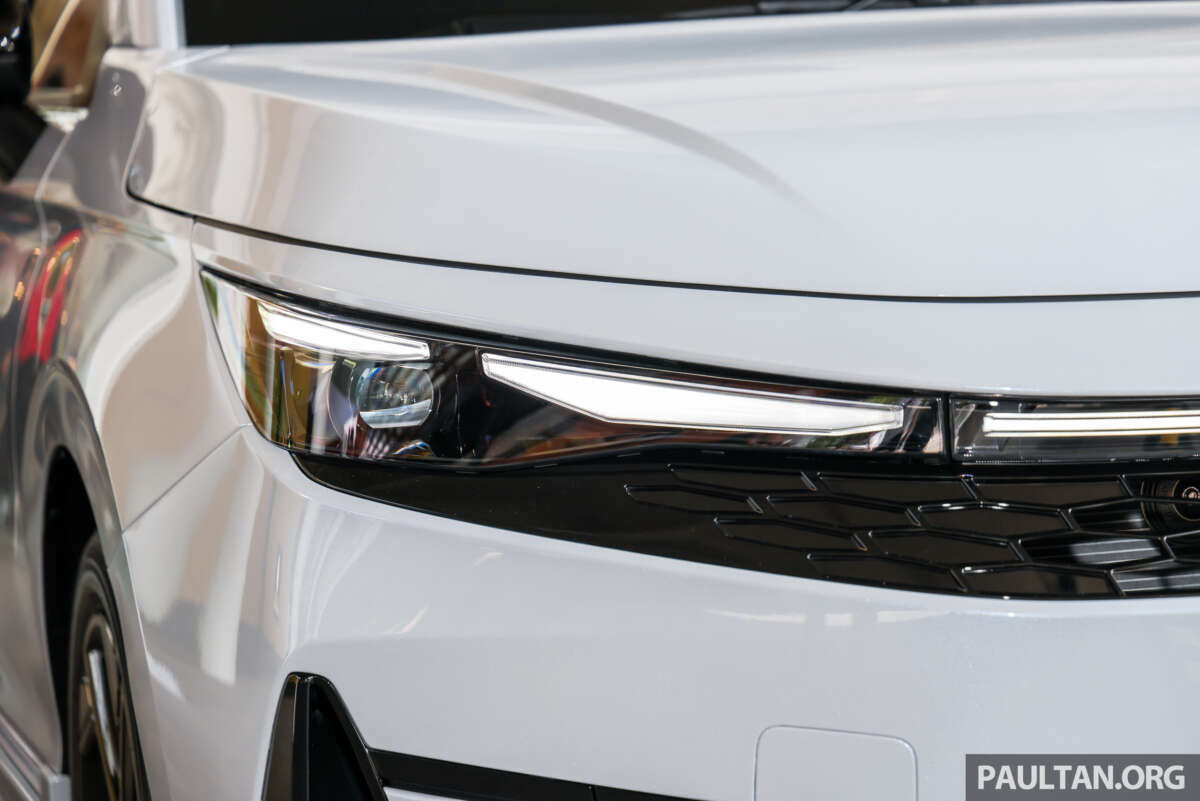
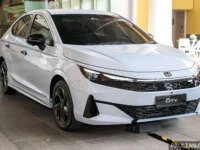
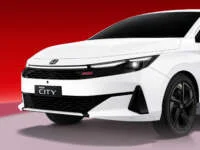
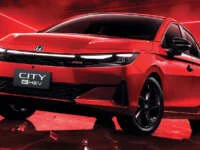
As indicated from the preview, the exterior rework for the GN2 brings about a sharper front end, with slimmer headlights and a new bumper, with different lower profiles depending on model grades – both RS petrol and hybrid versions feature a central air intake with a sharper, upturned design, while the non-RS petrol variants get a unit with a less edgier, downturned styling, flanked by aggressive-looking air curtain elements finished in black.
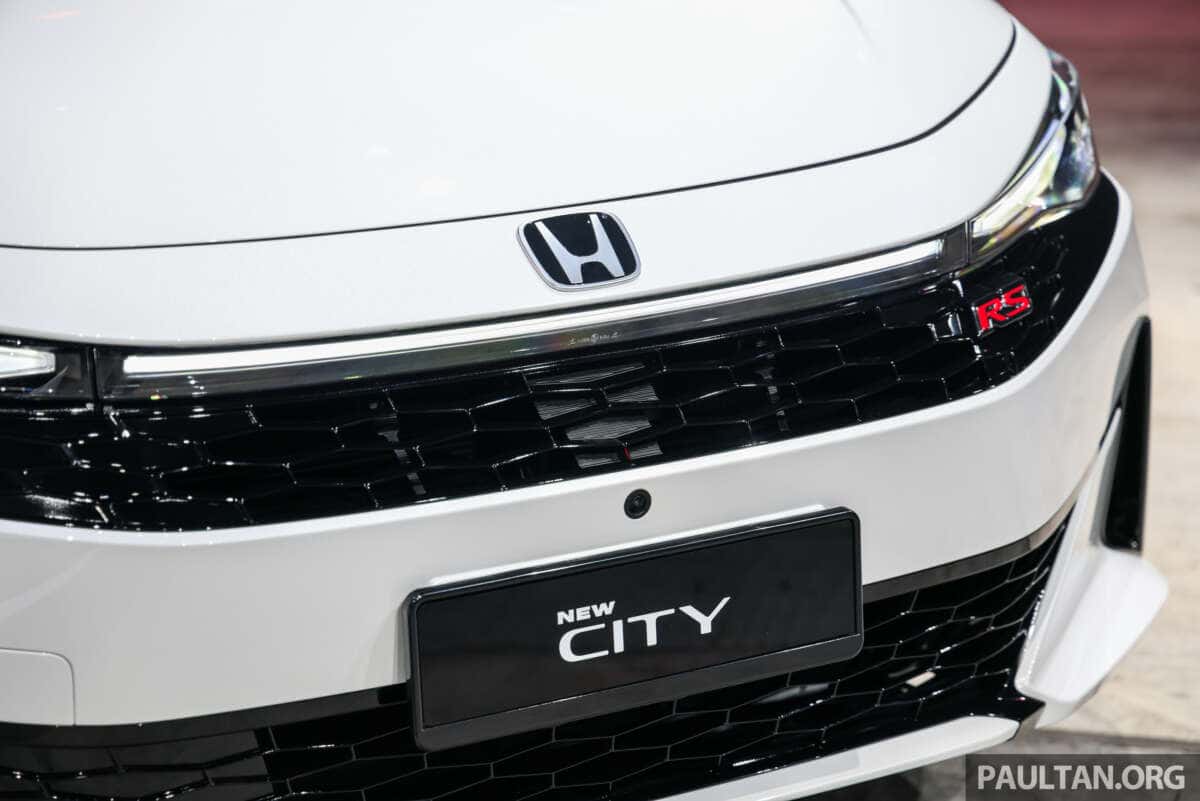
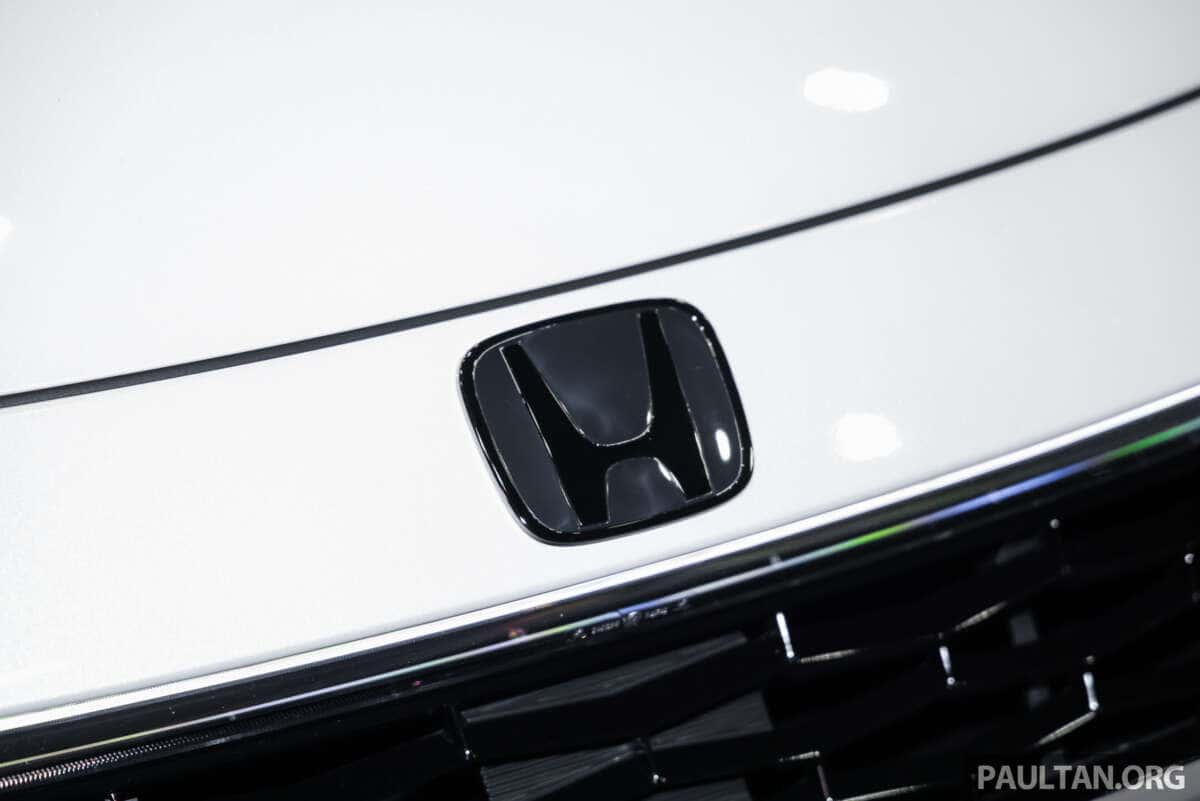
Elsewhere, the honeycomb grille has been slimmed down, and the Honda logo (which is still the old shape instead of the new “H” mark, but presented in a flat 2D style like on the Prelude) has been relocated from the grille to the upper part of the body-coloured ‘unibrow’ element. Unique to the RS is a light bar running across the width of the grille.


The refresh standardises the headlights to bi-LED projector units across the range, which means the E moves up from the halogen projectors from before, and its door handles are now body-coloured (previously, chrome).
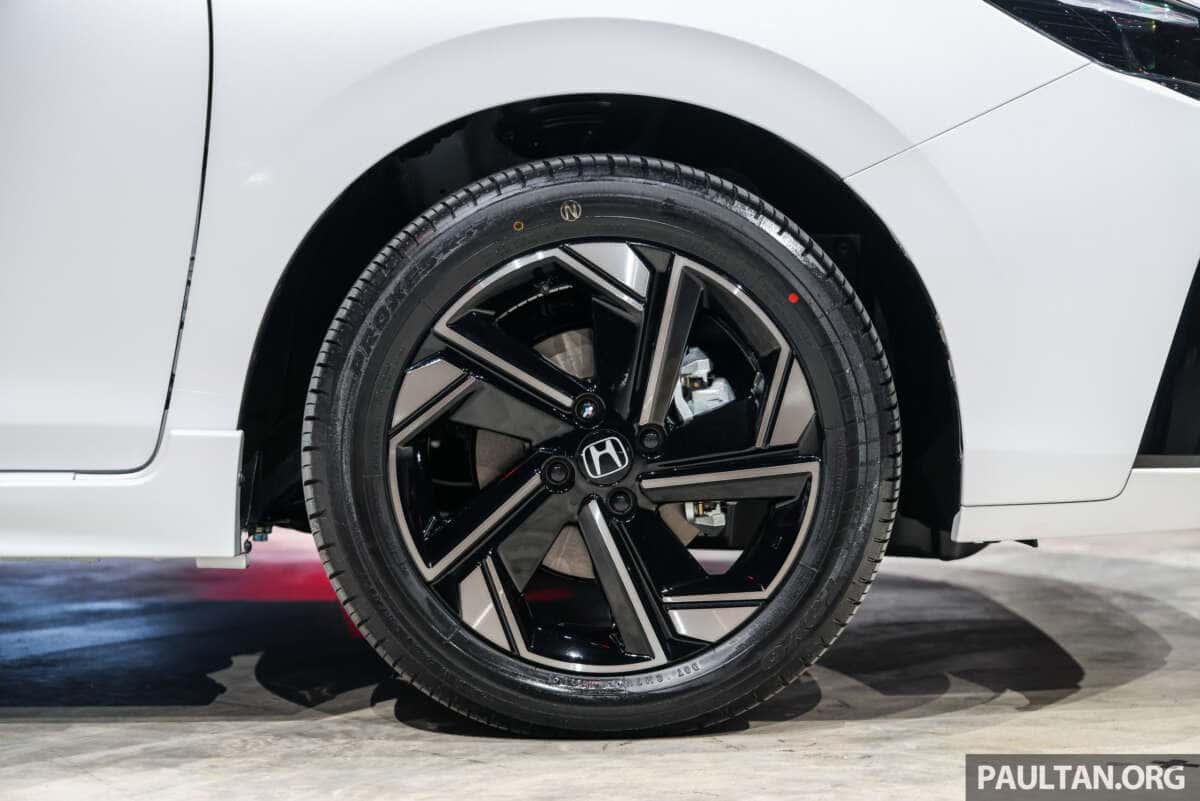
The E continues to ride on 15-inch alloy wheels, shod with 185/60 profile tyres, the only variant to do so. The V and RS are equipped with new 16-inch turbine-style units, the ones on the V finished in Shark Grey and on the RS, in Berlina Black with a darkened machined face, wrapped with 185/55 series Toyo Proxes R57 rubbers.
A note about the spare tyre – while it was never provided with the e:HEV, it has now been dropped from the petrol City variants. There’s no specific reasoning for this, but the company highlights that it’s safer and faster to use tyre repair kit, spending less time at a road shoulder. In any case, for major tyre damage, HIP offers 24/7 towing assistance to a tyre shop.


Meanwhile, the rear retains its familiar shape, but of course there are styling changes. There’s a redesigned rear bumper, which is dressed up with a black grille-like “mesh” centre, a diffuser-like insert, twin “tusks” and vertical reflectors. The trapezoidal tail light design has been carried over, but the unit on the RS now gets an ‘albino’ look, its internal design elements presented in a mix of clear and black, lighting up in red when active.
Mimicking the Civic RS in visual approach, the RS versions of the City get plenty of black elements, in this case on a trunk spoiler extension, door handles, shark fin antenna and side mirror covers.
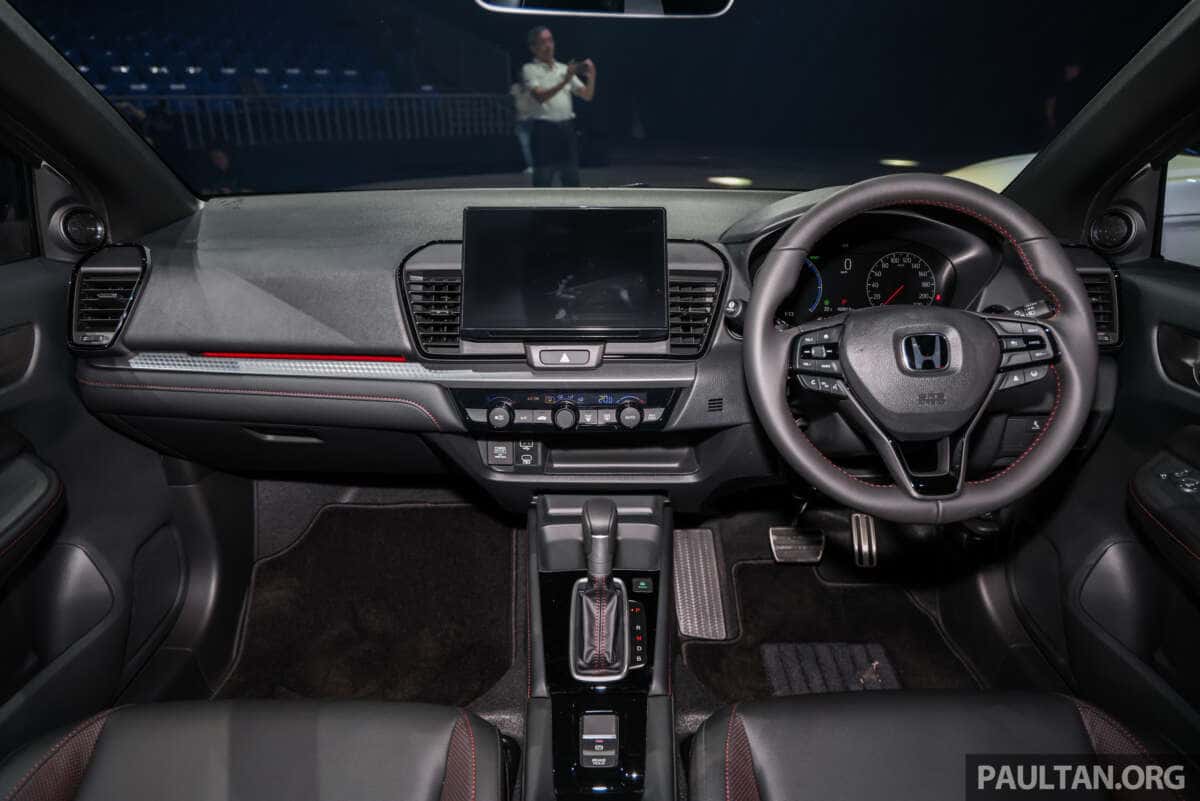
The interior is unchanged in terms of layout and configuration, but some areas have been upgraded. The dashboard trim on the RS moves away from the all-red finish previously to a more textured 3D silver finish (with a red accent line), and it also gains ambient lighting, red for the RS and blue for the V. The side mirrors also gain an autofold function from the V on, and the RS now gets an auto dimming rear view mirror.


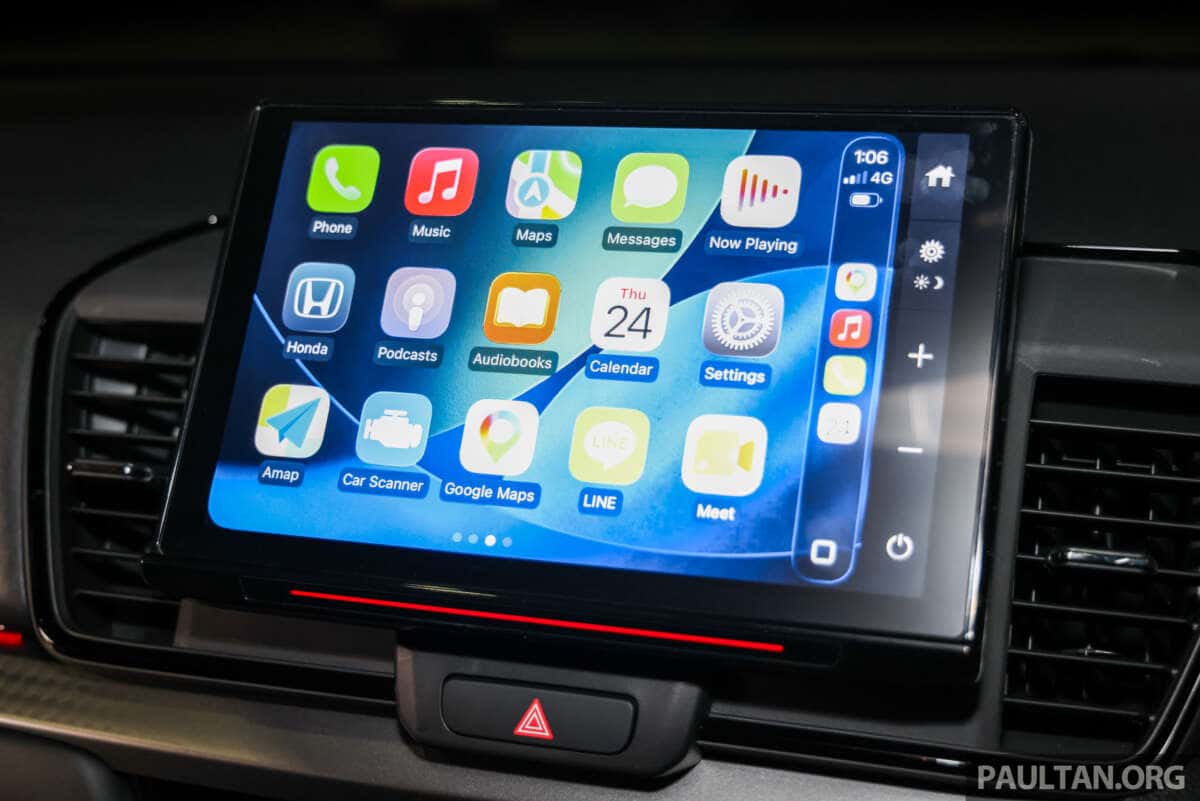
While the E continues to feature the same eight-inch Display Audio touchscreen head unit with wired Android Auto and Apple CarPlay from before, the V and RS versions move up to a new, larger 10-inch Display Audio infotainment touchscreen.
The new unit, which brings wireless AACP to the V (wired, first facelift), comes with the 360-degree camera system that was added to the City earlier this year and has now been updated with a multi-view angle and moving object detection interface. A switch has been added to the tip of the left steering stalk to provide users with the ability to cycle through all the angles.
Meanwhile, besides the addition of a wireless mobile charger for the e:HEV RS, the RS variants get a new seat upholstery design – the central stitching on the previous facelift’s front seats has been ditched, the unit now plain, and the reddish contrast perforation surface on the central spine seen previously has been relocated, now placed on the sides. As mentioned in the preview post, the Malaysian-spec City will not get the ventilated seats or sunroof seen in other markets.


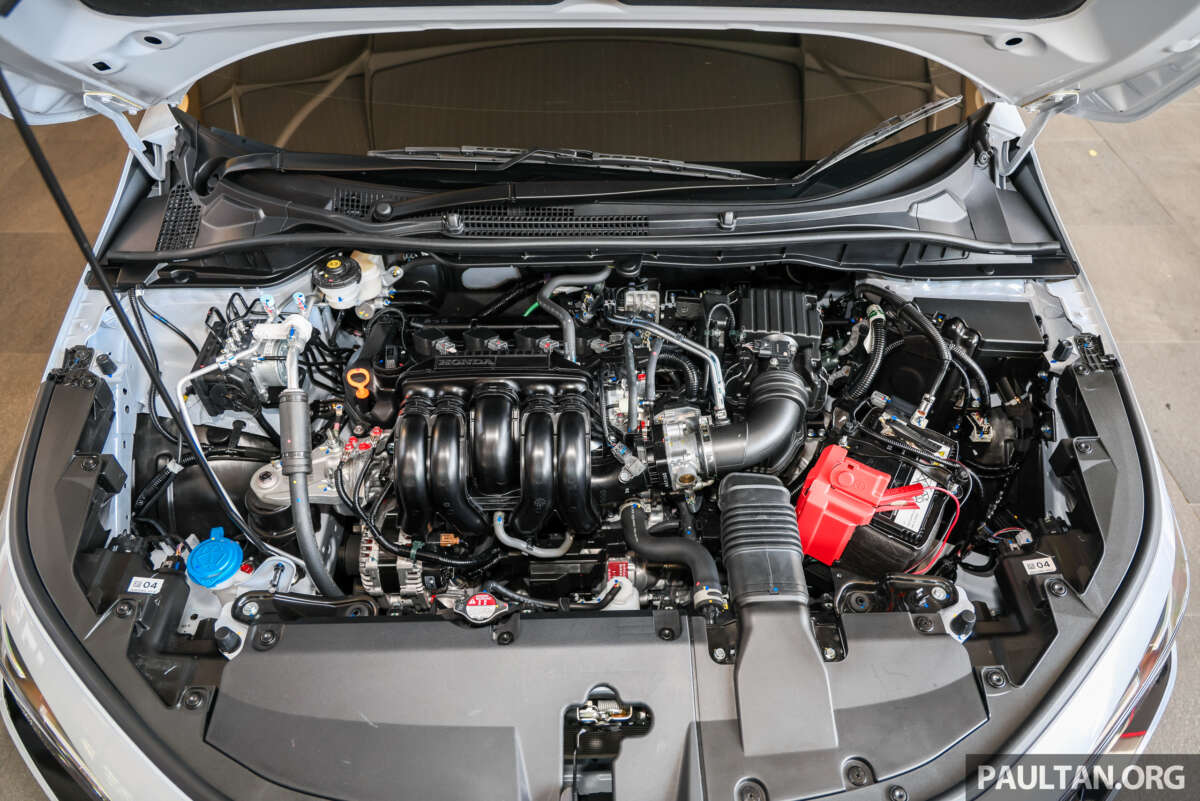
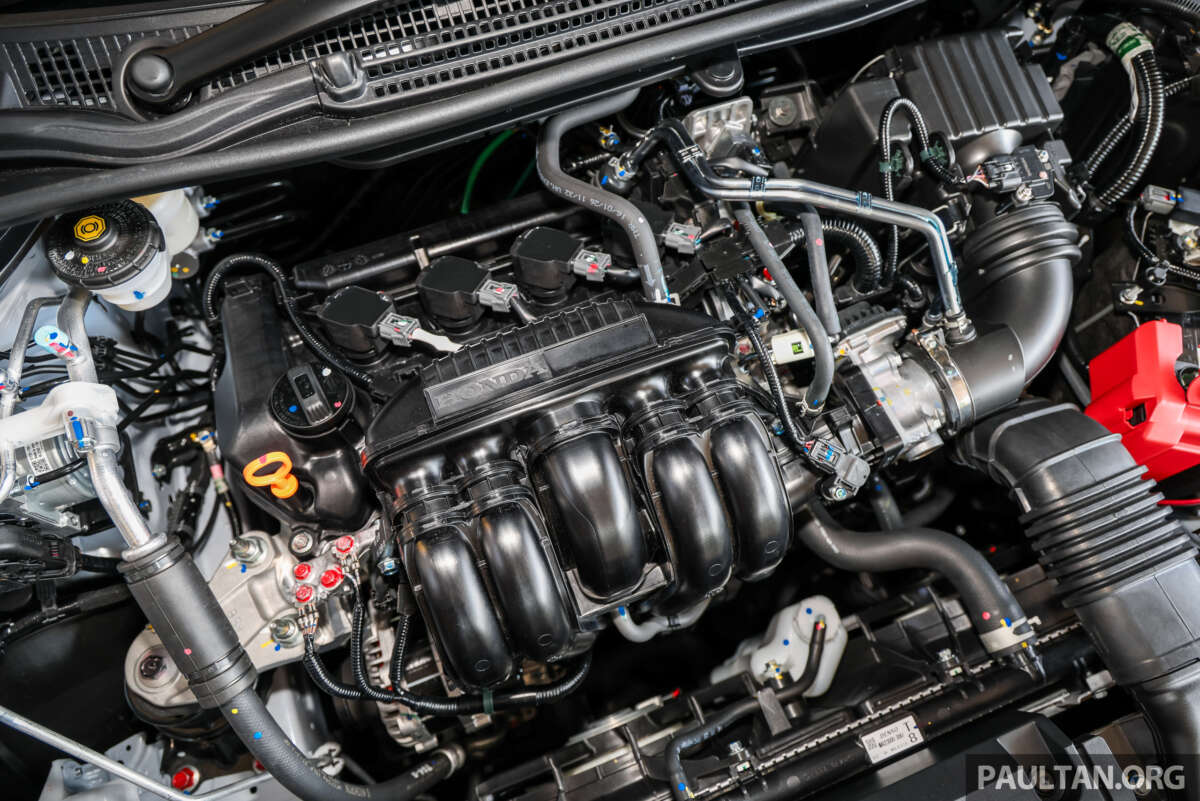
As for powertrain and outputs, the same options continue as they are from before. All three petrol versions have the familiar L15Z 1.5 litre DOHC i-VTEC four-cylinder, offering the same 121 PS at 6,600 rpm and 145 Nm at 4,300 rpm, paired with an Earth Dreams CVT.
Likewise, the i-MMD system on the e:HEV hybrid is also unchanged. The system consists of a primary electric traction motor with 109 PS and 253 Nm providing drive through a single-speed transmission, with an Atkinson-cycle version of the 1.5 litre mill acting as a generator to recharge the battery. The engine, which has 98 PS from 5,600 to 6,400 rpm and 127 Nm between 4,500 and 5,000 rpm, can also clutch in to provide mechanical drive at higher running speeds.
Safety-wise, the City facelift will continue to come equipped with Honda Sensing as standard. The driver assist suite includes autonomous emergency braking, adaptive cruise control (with low speed follow on the e:HEV RS), lane centring assist, road departure mitigation, front departure alert and auto high beam.


New to the 2026 car is blind spot monitoring with rear cross traffic alert, and this works with the existing LaneWatch camera to now provide alerts to the driver on both sides.
Here’s the spec walk-up, variant by variant – the full spec sheet is attached below.
City 1.5L E, RM89,900
- 1.5 litre NA i-VTEC, 121 PS/145 Nm, Earth Dreams CVT
- Bi-LED projector headlamps (up from halogen projectors)
- Body-coloured door handles (previously chrome)
- 15-inch alloys with 185/60 tyres
- Eight-inch Display Audio touchscreen, wired Apple CarPlay and Android Auto
- Six airbags, ISOFIX
- Smart entry with push start, remote engine start, walk-away auto lock
- Single-zone auto air-con with rear vents
- Paddle shifters, 4.2-inch TFT meter
- Honda Sensing – AEB, adaptive cruise control, lane centring assist, road departure mitigation, front departure alert, auto high beam
- New blind spot monitoring with rear cross traffic alert, plus LaneWatch
- 519 litre boot, tyre repair kit (no more spare tyre)
- Eight-year, unlimited-mileage warranty (all variants)
City 1.5L V, RM94,900 – adds:
- 16-inch turbine-style alloys in Shark Grey, 185/55 Toyo Proxes R57 tyres
- New 10-inch Display Audio touchscreen with wireless Apple CarPlay and Android Auto
- 7-inch TFT meter
- Combination leather upholstery, leather-wrapped steering wheel and gear knob
- Auto-folding side mirrors
- Door pocket, footwell and door handle illumination
- Blue ambient lighting
- Stellar Diamond Pearl colour option (V and petrol RS only)
City 1.5L RS, RM99,900 – adds:
- RS bumpers with upturned central intake, light bar across the grille
- ‘Albino’ tail lights, black trunk spoiler extension, door handles, shark fin antenna and mirror covers
- 16-inch alloys in Berlina Black with darkened machined face
- Textured 3D silver dash trim with red accent line, red ambient lighting
- 360-degree multi-view camera with moving object detection
- Auto front wipers, auto-dimming rear view mirror
- Sport pedals
- Honda Connect telematics
- New RS seat upholstery design
City 1.5L e:HEV RS, RM111,900 – adds:
- i-MMD hybrid – 109 PS/253 Nm electric traction motor with 98 PS/127 Nm 1.5 litre Atkinson-cycle engine
- Adaptive cruise control gains low speed follow
- Wireless mobile charger
- Electric parking brake with auto brake hold
- Deceleration selector paddles (in place of the petrol cars’ shifter paddles)
- 10-year hybrid component warranty on top of the standard eight years
- 0-100 km/h in 9.7 seconds and 3.7 l/100 km (petrol: 10.2-10.4 seconds, 5.6 l/100 km)
- Boot shrinks to 410 litres; no Stellar Diamond Pearl option
The exterior colour palette has been scaled down from six on the old car to four now, the range consisting of Blazing Red Pearl (which takes over from Ignite Red Metallic), Meteoroid Gray Metallic and Platinum White Pearl and Stellar Diamond Pearl, the latter only available for the V and petrol RS. The Blazing Red Pearl and Platinum White Pearl are an additional RM400 cost option.
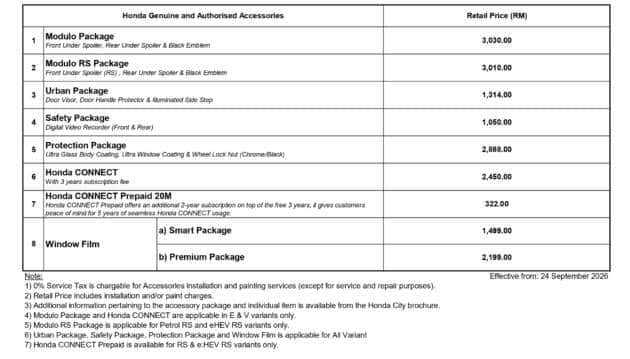
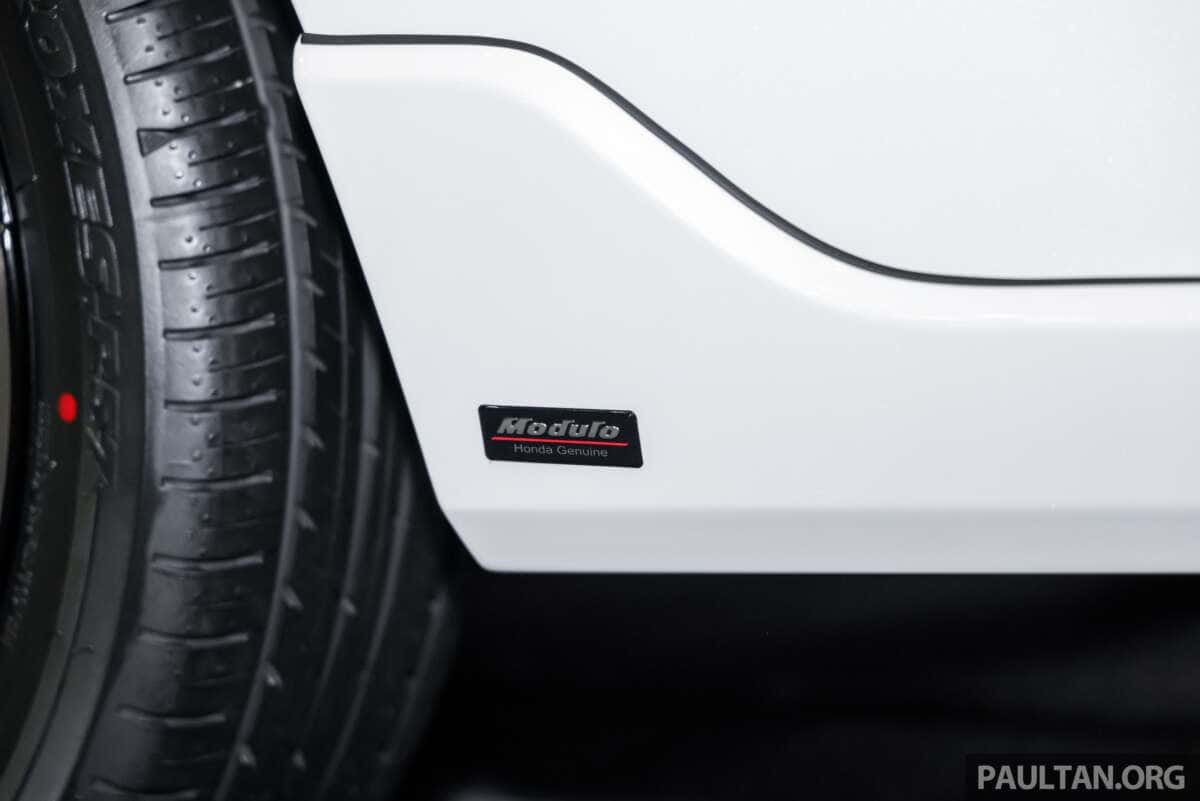
As it was with the initial facelift, Honda Malaysia is offering a range of optional accessories for the City, including two Modulo styling kit packages, each of which consist of front/rear under spoilers and a front/rear black Honda emblem set. While the front under spoiler is slightly different for the non-RS and RS packages, the rear unit is identical for both packs.


GALLERY: 2026 Honda City sedan facelift, e:HEV RS











GALLERY: 2026 Honda City sedan facelift, e:HEV RS with Modulo package





GALLERY: 2026 Honda City sedan facelift, petrol RS







GALLERY: 2026 Honda City sedan facelift launch presentation slides





 Honda City
from RM89,900
Honda City
from RM89,900  Honda WR-V
from RM94,900
Honda WR-V
from RM94,900  Honda Prelude
from RM278,000
Honda Prelude
from RM278,000  Honda HR-V
from RM115,900
Honda HR-V
from RM115,900  Honda e:N1
from RM149,900
Honda e:N1
from RM149,900  Honda Civic
from RM133,900
Honda Civic
from RM133,900  Honda City Hatchback
from RM85,900
Honda City Hatchback
from RM85,900  Honda CR-V
from RM178,200
Honda CR-V
from RM178,200  Honda Civic Type R
from RM399,900
Honda Civic Type R
from RM399,900 

can buy later as Honda will give RM8k to RM10k as usual.
Yep, wait year end sale or CNY sale next year
3K kedekut teriuk
tunggu 10K baru action
After 3 years, you see the cina car body part start corrosive. See the cina aircond u know
Geely X70 already six years old, ok je
Proton already give discount on their newly launched S70 N/A.
With HONDA Logo
You dunt eat MoonCake Bcos you cannot afford to BUY MoonCAKE
thank you johari for ensuring malaysia rakyat will continue to suffer from having to pay exorbitant prices for 3rd world subpar cars like this
Nice to see the exterior has picked up Honda Prelude styling vibes. But it’s fighting a massive uphill battle now with pricing that puts it above the S70 1.5T while offering performance that is the same (except for the e-HEV RS) as the RM40k cheaper S70 Lite and Prime.
Literally a day late and a dollar short,
It surely will face very tough competition against Chinese B-SUVs: Tiggo Cross hybrid, Jaecoo J5.
If these cars are proven to be reliable after 5 years, expect Honda Malaysia to be in serious trouble. Judging by numerous old 1.8T X70s still running on our roads.
Honda is still dreaming they own the market. No one’s buying Hondas anymore. Stripped so many features yet dare to charge a premium.
Naaa … S70 NA je…
Rooting for them, but I’m not sure that with this pricing, they can really compete, considering Proton has already introduced many class-leading features at a much lower price point. With Honda after sales reputation seemingly going downhill recently, there’s a real possibility that, sooner or later, they could become a low-volume seller.
The only things Honda can really do, apart from offering an 8 year unlimited-mileage warranty, are to provide truly world class after sales service. Such as implementing a proper buyback / lemon law style policy, even though a formal Lemon Law has yet to be recognized in Malaysia. Along with better parts availability, faster warranty claims, courtesy cars for lengthy repairs and stronger accountability when recurring defects occur.
conti killer madani taxi S70 – MYR60k
honda city with steering rack issues and lousy CVT – MYR90k
like for conti killer, dislike for USA & Israel friend Japan
RS trim same price as X90 turbo inline 4 that seats 7, crazy time we are living in right now….
Ugly design and overpriced
fix the quality issue otherwise… hard to sustain
Looks awful than the older City FL. Rims are ugly.
The S70 should give better shoulder/hip room than the City at a much lower price point. Besides, nicer suspension & drive feel too.
give me the same amount of money. rm112k and I’ll wait for the Proton emas 7 facelift next year. Thank you.
Honda and Toyota, by 2035, you will regret the decisions taken in 2026. Start selling EV right now!
We the orginal buyer has been fleeced!