

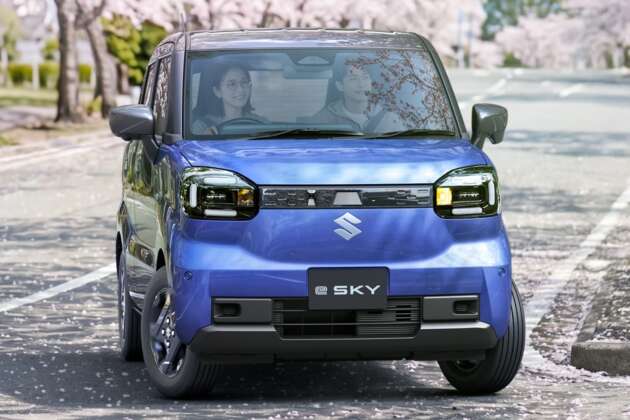
Small car specialist Suzuki has revealed the eSky, its first electric kei car and the latest entry into a burgeoning segment that also includes the Honda N-One e:, Nissan Sakura, Mitsubishi eK X EV and the interloper, the BYD Racco. The big news is that this particular little tyke is set to be exported – following in the footsteps of the Honda, which became the Super-One.
Details have not been released publicly as yet, but Japanese publications such as Creative Trend report that the car will make the city car category’s agreed 64 PS (47 kW) and a peak torque of 133 Nm. The latter figure is nearly 30 Nm less than the N-One e: and Racco and over 60 Nm less than the Nissan and Mitsubishi twins.
This deficit in twist does seem to have helped range – despite its middling 26 kWh battery capacity, the eSky is said to be capable of travelling up to 310 km on Japan’s more lenient version of the WLTP cycle. This bests all but the Racco, which needs a 35.84 kWh Blade LFP pack to go just 10 km further. Its scant kerb weight of 1,030 kg (matching the Honda) will have something to do with it, being 200 kg lighter than the sliding door-equipped BYD.

Unlike Honda, Nissan and Mitsubishi, Suzuki’s kei EV isn’t based on an existing ICE model; rather, the eSky reportedly utilises the same Heartect-e platform as the eVitara. While DC fast charging is capped at 50 kW, the small battery means the car can be topped up from 10 to 80% in a reasonable 25 minutes, although AC charging is limited to a measly 6 kW.
Previewed by the Vision e-Sky concept at last year’s Japan Mobility Show, the eSky retains that car’s upright body, three-point C-clamp front and rear lighting signatures, wraparound front and rear windscreen design, body-coloured C-pillar insert and contrasting roof.
Obviously, the most fanciful features such as the front light bar, flush pop-out door handles, sleek door mirrors and large wheels (replaced by skinny 14-inch black alloys) have been dispensed with, but this is still an exceedingly cutesy car in keeping with class norms. Also in keeping are dimensions of 3,395 mm long, 1,475 mm wide and 1,625 mm tall, although its 2,460 mm is the shortest in the class.

The eSky’s simple interior is typical kei car, if not as futuristic as the Racco’s. You get a calculator-style seven-segment LCD instrument cluster with a small multi-info display, along with a 10.1-inch infotainment touchscreen that’s said to be a first for Suzuki’s kei models, paired with a rather anachronistic tall gearlever.
Storage spaces are aplenty, with a dashboard tray, lots of cubby holes and open storage on the centre console. Also fitted is a 100-volt, 1.5 kW rear power outlet that allows users to charge laptops and power appliances. The car is set to be launched in Japan around the fourth quarter of the year.

As mentioned, the eSky is expected to be exported to Europe and the UK according to Nikkei Asia, with Autocar adding that the car will debut in Britain as early as next year. It’s unclear if it will be modified – with a wider body or a more powerful motor, for instance – to meet the needs of customers abroad, like with the Super-One.
While the Super-One was exported to much of Southeast Asia, plans for it to be sold in Malaysia were curtailed by the reintroduction of import and excise duties for EVs, and MITI’s latest EV policy buried it. We expect the same to be the case for the eSky, as it wouldn’t be able to meet the ministry’s 245 PS minimum power output or minimum value of RM200,000.


 Suzuki eVitara
from RM188,000
Suzuki eVitara
from RM188,000  Suzuki Fronx
from RM130,888
Suzuki Fronx
from RM130,888  Suzuki Jimny 5-Door
from RM199,950
Suzuki Jimny 5-Door
from RM199,950  Suzuki Jimny
from RM158,900
Suzuki Jimny
from RM158,900  Suzuki Swift Sport
from RM130,900
Suzuki Swift Sport
from RM130,900 

The numbers of orders for K cars is testamount to the poor education standards of Malaysia.Unintelligent people end up buying this car for a premium while Perodua and Proton sells the better car for 20k less. The difference in specs is not at alll worth 20k.This is without even talking about Chinese cars at the same price range which is leaps and bounds better than the Honda. I guess it’s the brand name
MITI must ban this EV to protek the local automotive industry of 700 thousand malay and bangla jobs
the ads are very misleading, i do not believe i will feel joy and laughter sitting in such a crampy car
The Suzuki eSky electric kei car features a 26 kWh under-floor lithium iron phosphate (LFP) battery pack sourced through BYD’s corporate supply network. This battery delivers a class-leading efficiency range of up to 310 km on a single charge.
Small 155 tyre helped the efficiency while rivals using up to 185mm for safety, stability, grip and comfort.