

The Geely Starray EM-R celebrates its world premiere with its launch in Thailand earlier today. This is Geely’s first range extender EV to be sold globally, and if you’re wondering why it looks very similar to the Starray EM-i (known to you and me as the Proton eMas 7 PHEV), that’s because it’s almost exactly the same car.
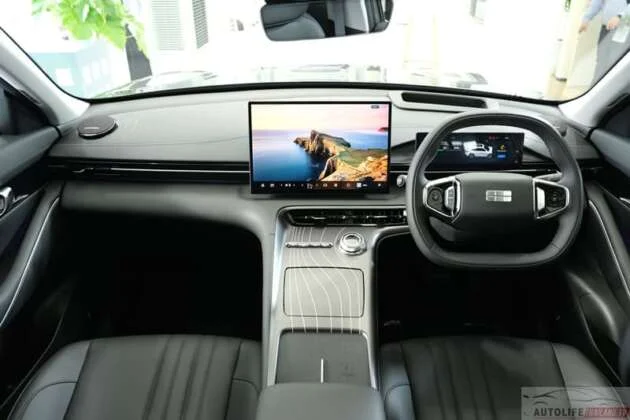
That means the exterior has been left untouched – same front light bar, Porsche Cayenne-esque rear and 18- and 19-inch wheel options. Ditto the interior, which has been carried over almost wholesale from the EX5/Proton eMas 7, including the 10.2-inch instrument display and 15.4-inch infotainment touchscreen.
Even the powertrain is mostly the same – you get a 218 PS/262 Nm electric motor, an 11-in-1 single-speed transmission and a 99 PS/125 Nm 1.5 litre naturally-aspirated engine functioning as a generator. The 18.4 kWh CATL LFP battery is the smallest available globally and delivers an NEDC range of 104.8 km (the PHEV achieves a WLTP figure of 83 km). With DC fast charging support up to 30 kW, it can be topped up from 30 to 80% in 20 minutes.
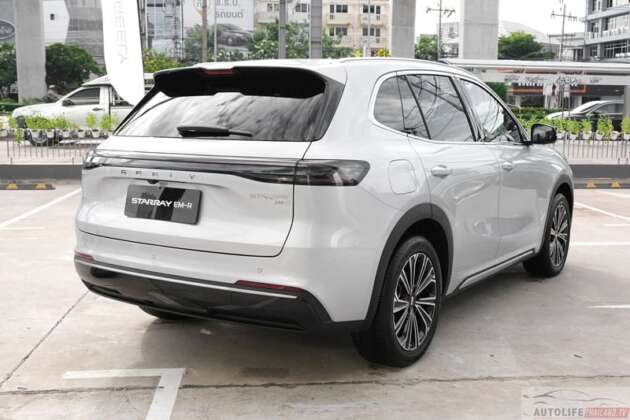
The difference is that the REEV loses the clutch connecting the engine to the transmission and thus, the front wheels. That means drive power is purely electric; the car can’t call upon petrol assistance at higher speeds where it is most efficient, and it also doesn’t get the full combined 262 PS of the PHEV. This will likely have an effect on the combined range (the PHEV gets 943 km WLTP, 1,000 km NEDC), although Geely did not announced a total figure for the REEV.
The main benefit of this tiny change is the reduction in tax. According to Autolifethailand, the Land of Smiles classifies cars driven purely by electricity as EVs, even if a combustion engine is the one generating that electricity.
As such, vehicles such as REEVs are exacted a 20% import tax rate compared to the 80% for ICE-driven cars – and that includes PHEVs. It’s the same reason why the forthcoming Nissan Elgrand e-Power (a hybrid that uses only an electric motor to drive the car) is expected to cost less than arch rivals Toyota Alphard and Vellfire Hybrid.
Thus, even though the EM-R is imported from China, it’s been able to be priced rather competitively, at 699,900 baht (RM86,400) for the Pro and 799,900 baht (RM98,800) for the Max. Even at current promo prices, the EX5 starts from 759,900 baht (RM93,800), whereas in Malaysia, the EV (from RM96,800) is cheaper than the PHEV (from RM105,800).
The equipment split between Pro and Max largely mirrors that of our eMas 7 PHEV Prime and Premium. The Pro gets 18-inch wheels, manual seats, dual-zone auto air-con, six speakers, a reverse camera and Level 2 semi-autonomous driving functionality.

The Max adds 19-inch rollers, power-adjustable front seats, a head-up display, a 360-degree camera system, a powered tailgate, blind spot monitoring and rear cross traffic auto brake. No mention of a massage function, as added to the eMas 7 PHEV Premium and Premium Plus on the forthcoming locally-assembled models.
While Thai distributor Thonburi Neustern classifies this as a world premiere, the reality is that the EM-R is likely a market-specific offering and probably won’t be offered elsewhere. This also means the Proton eMas 7 PHEV should soldier on as before, delivering more power and more efficient highway running.


Proton sold at higher price so that more tax money for gomen. Important for annual budget that help country grow. Inshallah.
Nope. That extra. Money goes to drb hicom.
Government collect corporate tax from Dr Hicom through LDHN
Afterall, proton not that cheap.
Proton!! Do your job, bring this in!
Johari protek apa
protek corrupt cronies and tongkat them sampai mati lah apa lagi?
With prices like this, who needs Proton anyway. Just sell under Geely here.
imagine if we can enjoy the eMas7 PHEV at RM86k.
that is why i think p1 and p2 doing more harm to Rakyat than good.
Extended range EV should. Incur less taxes than ICE ars if gomen serious about reducing oil consumption.
Can buy two with one crv price car size same crv and has better features