
How often have you heard people who don’t believe in electric cars wish a new EV owner good luck because they think it’s likely that the new owner will have to deal with very expensive battery replacement cost in just 5-6 years.
Perhaps we can’t blame them as many are merely speaking from how hybrids and plug-in hybrids of the last generation often require expensive battery replacements due to the often poor placement and stressful conditions that hybrid batteries have to work in. But how have electric cars, built on purpose built dedicated platforms, fared against the test of time?
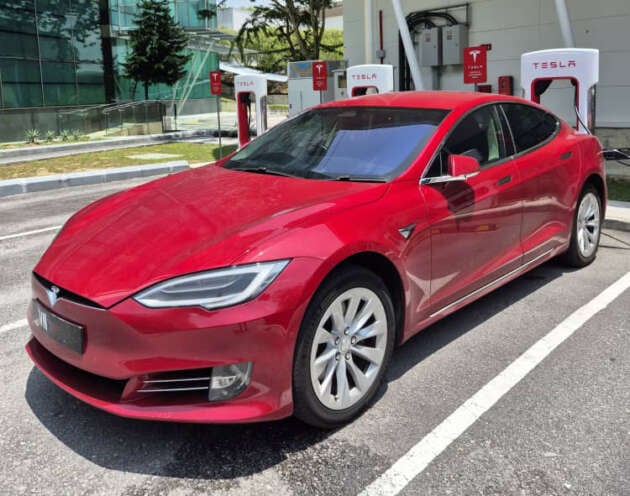
We decided to look into the condition of a 2017 Tesla Model S 75, which was brought into the country as part of Malaysian Green Technology Corporation’s Tesla leasing program fleet almost a decade ago. At time of test, the car’s mileage was around 116,000 km.
We performed an Aviloo Premium Test on the Tesla Model S to determine the battery state of health. To perform an Aviloo Premium Test, a device is connected to the EV and then the EV must be charged to 100%.

While the device (called the Aviloo Box) remains connected, the EV is driven down to 10% state of charge through normal day to day use, within 7 days.
The test is then considered complete, and the Aviloo Box sends the data it collected to Aviloo through the built in cellular data connection. An independent Aviloo Battery Certificate is then generated.
The Aviloo Premium Test doesn’t simply read the figure reported by the car’s own battery management system (BMS). The State of Health value reported by the BMS is based on manufacturer-specific algorithms and can differ significantly from the actual state of the battery, sometimes reading too high or too low.
Aviloo instead generates its own independent assessment from raw data captured during the full discharge cycle. During the test drive, data such as current, cell voltage and temperature are recorded in real time and processed in the cloud, with the analysis performed at cell level and accounting for parameters like internal resistance, time constants and resting voltage curves. Rather than using the common average-cell method, Aviloo’s calculation focuses on the weakest cell and measures usable energy under defined conditions.

The results? Aviloo determined that the Tesla Model S still had 83% of its original battery capacity left, which left it with 344 km of WLTP range, down from 414 km WLTP range when it was new.
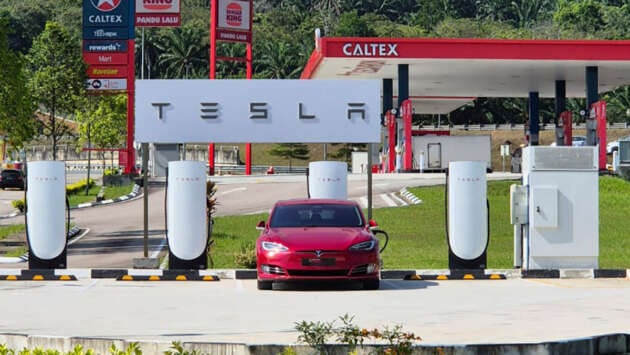
Interestingly, the owner’s usage behaviour involved using DC fast charging almost 90% of the time, usually from a 20-30% battery level up to 80-90%. The reason for this is because that batch of Tesla Model S came bundled with free lifetime supercharging, so once Tesla Malaysia opened its first superchargers here, it had been running on free electricity the whole time.
So yes, this EV did not need to have its battery pack changed after a decade due to supposed heavy degradation, let alone just 5-6 years as the common misconception is. An EV battery is not like an iPhone battery where the state of health goes under 80% after just a year of usage.
In any case, battery warranties typically last around 8 years depending on brand, with Mercedes-Benz Malaysia being the most generous with a 10 year battery warranty.
Of course fringe cases may exist, so if you’re in the market to buy a used EV, you can ask for it to be tested with an Aviloo battery test. There is another version of the test called an Aviloo Flash Test that is able to identify issues with the battery pack as well, at a lower price and time cost. It is based on a machine learning model trained on Aviloo Premium Test data. Using predictors such as vehicle age, mileage, and charging behavior, the SoH is determined in just three minutes, without fully discharging the battery.
What do you think of the Tesla Model S tested state of health – is 83% after nearly a decade an acceptable ownership experience?
Bought a new Tesla? You need to make sure it has an insurance cover note 7 days before delivery day. You can use our Tesla Insurance service to get it insured.
 Tesla Model Y
from RM198,000
Tesla Model Y
from RM198,000  Tesla Model 3
from RM149,000
Tesla Model 3
from RM149,000 

But still no one will buy an 8 year old second hand EV
i think plenty of people will buy japan Taycans bro
japan taycans arent eight years old
The matric is wrong
83% SoC doesn’t means
83% of mileage remains
Just as your old phone
100% used to hold 2 days
But decrease to 1 day
How you know ? SKL
The USP for this Tesla is the FREE LIFETIME SUPERCHARGING so that is a killer bonus man
Straight on point. Dont know others, At least I and my whole family wont.
how many kms has this tesla clocked in the 9 years of its existence?
116000km
thanks for the datapoint.
bro cant read
are u here to troll or get educated?
as recommended.. 80% charing.. and use until not less than 10%… 70% of 344… merely around 240km… cant even reach KL.. and need a chargiing in between… people long ago reach destination already…
You everyday drive pg-kl ?
Haha
serve those early adopters right for buying an EV in 2017 when the tech was still not yet mature. they should have waited until 2026 today even a cheap EV can easily do 400km and can charge till full without damaging battery.
why not wait another 50 years
No need rest in between? you power
How about maintenance record to show the overall cost of ownership? Nice advert
Some high mileage tesla taxi used in temperate climates shows good battery degradation but worn out headlights, wiper arm crashing into the hood. Worn out as in progressive headlight dimming or burnt drl. Base model cost 1.2k usd each.
Someone should not even buy a 10 years old EV if frequent travelling long distance, U will have other better choices. But for the new generation EV, it range already reaching 600 km and above, so it should be more time.proofing.
What company made the battery for Tesla? Writer didn’t mention it…
Panasonic
Pretty low mileage to consider that a 2017 car is pretty much 10 years old. The average Malaysian car has roughly 20,000km mileage a year,in fact nowadays safer to say it is more like 2,000 km a month or 24,000km annually. Meaning a 10 years old car should probably clocked 240k km instead of 116k km. No doubt, there are cars with such mileage but we consider those as low mileage and not average since there are many cars clocking 3,000km a month (36k a year) with grab drivers easily doing 5k km a month.
I say this SOH test is not pretty much justified unless buyers or owners of EV chose to use the car for only 1,000km a month and nothing more.
it makes sense because back in 2017 if the effective range of this car is only around 300km then it would not practical for long distance travel. hence the low mileage.
Spot ON analysis ….based on mileage its like an average 5 year old car.
so my petrol car, not a hybrid, not a diesel… has done 83,000km since new from 2017….so 115,000 for me is high… not everyone go merayap every single day and weekend.
I don’t know about you but I don’t know a lot of people who drive an average of 60 km a day (my yearly mileage is just over 12,000 km), especially in KL where the usual daily commute is closer to 50 km a day. Not to mention that there is such a thing as weekends, as well as days when people work from home (very common post-pandemic). There are a lot of people who do that kind of mileage, sure, but to say that 240,000 km in ten years is the standard in Malaysia is a bit of a reach.
This is like those scammer medication product marketing. They will site one “study” saying it is good but conveniently skip mentioning the dozen other studies that say it’s bad.
You say the company’s calculations may differ from the car’s own BMS readings, but you did not provide us that as a comparison.
I suspect the car’s BMS battery health is close to, if not identical to the 83%. PT has financial ties to the company so this is essentially an ad.
The main takeaway is that the statement “………new owner will have to deal with very expensive battery replacement cost in just 5-6 years.” is complete and utter BS because new owners get 8 years of battery warranty.
Come on people
Model S uses NCA chemistry which degrades faster than NMC and LFP. NCA is no longer used in the industry
mileage of 116k km over 10yrs suggest the car was barely used.. battery performance deterioration depends more on charge cycles as opposed to time.. go figure
I believe there is a expertise gap between EV and ICE cars. A 2nd hand ICE can always be renewed or restored with present tools and materials, but not a 2nd hand EV where most mechanics are not electronics savvy. The battery pack needs expert technicians to replace it. Their price is still debilitating to most car owners.