Advertisement
Follow us:
Advanced search
           
Browse all EVs
           
Browse all used cars
           
Sell your car, get paid fastFree inspection · fast payment Sell for a higher price Add paultan.org as a preferred source on Google Add
 

Perodua QV-E review - all the good and bad

Sell your car for a higher price, get paid in 24 hours

Latest Stories

  • Xiaomi Auto to enter Europe in 2027 – MOUs signed with 8 German dealers, not Tesla-style direct sales?

    Xiaomi Auto to enter Europe in 2027 – MOUs signed with 8 German dealers, not Tesla-style direct sales?

    Xiaomi has taken its first concrete step towards selling cars outside China. At the IFA Berlin 2026 consumer electronics show, the company signed memoranda of understanding with eight German dealer groups, confirming that its official European market entry will happen in 2027, starting with Germany before expanding to other markets on the continent.

    The eight groups are Ernst Dello, Autohaus Dinnebier, Emil Frey Germany, Fett & Wirtz Automobile, Hahn Automobile, LUEG Mobility, Penske-Jacobs Innovation and SPT Avior – established names in German automotive retail, with Emil Frey being one of Europe’s largest dealer groups. The MOUs are non-binding for now, and Xiaomi has yet to disclose which models will be sold, local pricing, store counts or sales territories.

    “Xiaomi Auto is committed to long-term investment in Europe,” said Yu Liguo, Xiaomi vice president and head of its international business, adding that local partnerships are central to the company’s expansion strategy. The carmaker already has an R&D centre in Munich, and it launched its global automotive website and international social media channels in late August.

    The obvious candidates for export are the SU7 sedan – which has racked up over 500,000 deliveries in China since its launch – and the YU7 SUV, which famously logged 240,000 locked-in orders within 18 hours of going on sale.

    Also in the stable are the SkyNomad N70 and N90, extended-range electric SUVs that would sidestep Europe’s patchy charging coverage outside the big cities. In total, Xiaomi has delivered more than 700,000 cars in China to date.

    Dealers, not direct sales – and what that means for Malaysia

    Perhaps the most interesting takeaway isn’t the where, but the how. In China, Xiaomi sells its cars direct through its own stores, much like Tesla does globally. For its first export market, however, it has chosen to sign up franchised dealer groups – suggesting that Xiaomi is comfortable working with third-party retail partners abroad rather than replicating the capital-heavy, Tesla-style direct-sales model in every new country it enters.

    Xiaomi Auto to enter Europe in 2027 – MOUs signed with 8 German dealers, not Tesla-style direct sales?

    Which brings us to our shores. Back in July, we spotted a Xiaomi job listing on LinkedIn for a government relations manager (automotive) based in Greater Kuala Lumpur – a role that involves dealing with MIDA, MITI, MARii and customs on tax incentives, and advising on “CKD & CBU market operations”.

    Group president William Lu has said Xiaomi will begin its global EV expansion by 2027, and with Europe now formally pencilled in for that year and groundwork seemingly being laid here, Malaysia may not be far behind.

    If the German playbook is anything to go by, Xiaomi could arrive here hand-in-hand with a local distribution partner rather than on its own – the question is if that is the case, who.

     
  • Carro Care body & paint promo – 30% off full car respray from RM2,100, free naxPro kit worth RM270

    Carro Care body & paint promo – 30% off full car respray from RM2,100, free naxPro kit worth RM270

    Faded clear coat, swirl marks, that one scratch you’ve learned to ignore – paint is usually the first thing to make a perfectly good car feel old. A full respray fixes all of that in one go, returning that showroom shine for a fraction of what a new car would cost you.

    If you’ve been putting it off, Carro Care’s body & paint promo runs until October 31, 2026. A full car respray is going for 30% off, priced from RM2,100 – and every respray comes with a set of naxPro car grooming products worth RM270, so you can keep that fresh coat looking its best long after your car rolls out of the paint booth.

    Booking is simple – click here, fill in your name and contact details, and the Carro Care team will get in touch to sort out your quote and slot.

    The work is done at Carro Care’s dedicated body & paint centre in Taman Perindustrian Puchong.

    VIDEO: Perodua Myvi full car respray

    Still on the fence? Watch what a full respray did for this Perodua Myvi – the owner sent it in for the complete treatment, and the before-and-after speaks for itself.

    Remember, the 30% discount and free naxPro kit are only on the table until October 31, 2026submit your details here to lock in the promo price.

     
  • Proton sold 22,632 units in August 2026 – 22.7% up from July, best ever monthly domestic sales volume, YTD 141k

    Proton sold 22,632 units in August 2026 – 22.7% up from July, best ever monthly domestic sales volume, YTD 141k

    Proton has announced its sales numbers for August 2026, with the automaker reporting that the month returned the highest monthly domestic sales volume in the company’s history. In all, total group sales (including exports and the smart brand) hit 22,632 units last month, which the automaker rather confusingly says marks the best overall monthly performance since January 2010.

    It could be likely that Proton’s group sales in January 2010 was propped up by exports of the rebadged Youngman Gen2 models to China, but that remains conjecture – we have asked Proton to clarify the rather confusing claims.

    In any case, the figures for August represent a 22.72% – or 4,190 units – increase from the 18,442 units the automaker delivered in July. Year-to-date (YTD) sales for the first eight months of 2026 are now 141,421 units, which is 40.2% higher than the corresponding period in 2025. It estimates that its overall market share to be 27.9% for the month, while its YTD volume stands at 25.6% of the total industry volume (TIV).

    In terms of model specific numbers, no surprise to find the Saga yet again continuing to lead the way for the brand, with 7,347 units shifted last month. While this was 467 units (or 5.98%) less than the 7,814 units accomplished in May, the YTD figure of nearly 60,000 units keeps the model 33.3% ahead of that managed during the same period last year.

    As for the S70, sales passed the 3,000-unit mark for the first time, with 3,235 units delivered in August, an increase of 378 units (or 13.2%) from the 2,857 units achieved in July. Last month’s numbers brought the model’s YTD figure to 17,953 units.

    Meanwhile, 2,274 units (19,910 units YTD) of the X50 were sold in August, a slight dip of 17 units (or 0.74%) from the 2,291 units sold in July. Sales of the X90 MC amounted to 471 units last month, an increase of 30 units (or 6.8%) over the 441 units delivered in July. The automaker said that while total sales is comparatively small in the overall scheme of things, the model remains 64% ahead of its 2025 numbers for the same period.

    As for the brand’s electrified products, combined sales of the eMas 5, eMas 7 and eMas 7 PHEV reached 6,047 units, bringing the YTD sales for the range to 27,860 units. The lion’s share came from the eMas 5, with the 4,818 units sold in August setting a new national record for monthly volume from a single EV model. The eMas 7 managed 613 units last month, while the eMas 7 PHEV contributed to the total with 616 units.

    “By achieving the highest monthly domestic sales volume in Proton’s history, we have reached an important milestone that reflects the confidence customers place in our products and services,” said Proton deputy CEO Datuk Abdul Rashid Musa.

    “At the same time, we are making strong gains in our export business, particularly in the area of assembling vehicles for our partner Geely, while on-going efforts by the eMas team have resulted in the brand taking a dominant market share in the EV market. As a result, Proton is well-placed to reach its year-end volume and financial goals, benefitting the entire local automotive ecosystem as a whole,” he added.

     
  • Hanging MRT grounding cable in Cheras damages cars, injures motorcyclist – train operations safe, unaffected

    Hanging MRT grounding cable in Cheras damages cars, injures motorcyclist – train operations safe, unaffected

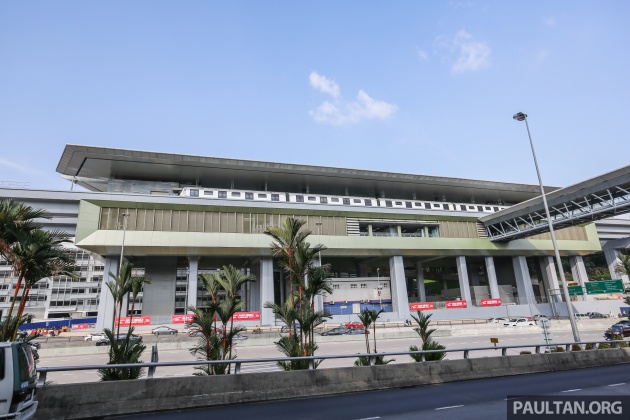
    There was an incident in Cheras this morning, where an earthing cable was hanging from the MRT Kajang Line’s elevated track. The stray cable, between Sri Raya and Bandar Tun Hussein Onn stations, damaged a few vehicles passing below, according to Rapid KL.

    The public transport operator said in a statement that it was informed that a motorcycle rider was injured. The rider was given emergency assistance before being ferried by ambulance to Hospital Kajang for further treatment.

    Rapid KL said that upon receiving information about the incident, its technical team went to the location to inspect and take immediate action. The stray cable was moved to ensure that it no longer poses a risk to motorists. They found that the elevated track’s structure and systems involved in train operations were not affected, and the MRT Kajang Line was safe to operate normally.

    “Rapid KL is cooperating closely with the highway operator and authorities to get further information, and perform a through investigation on the matter. Early investigations at the location found that the earthing cable was cut, and there’s a possibility of cable theft.

    “Rapid KL takes this incident seriously and will give full cooperation in investigations. The safety of passengers, road users and the public are always our priority,” the company said in a statement.

     
  • 2026 BYD Atto 3 Performance teased for Malaysia – AWD with 449 PS, 570 Nm, 470 km WLTP, limited units only

    2026 BYD Atto 3 Performance teased for Malaysia – AWD with 449 PS, 570 Nm, 470 km WLTP, limited units only

    When the facelifted BYD Atto 3 was launched in Malaysia in June, it was missing the all-wheel-drive range-topper, instead being offered only in front-wheel-drive Ultra and rear-wheel-drive Premium trims. Well, it turns out the AWD was to be offered later, as teased by Sime Motors dealer Beyond Auto.

    The car, called the Performance, will make its public debut on September 10 at selected Beyond Auto showrooms, with only limited units being made available. It shares the Evo mechanical makeover with the Premium, with the addition of a front motor pushing outputs to 449 PS (330 kW) and 570 Nm of torque.

    This is 136 PS (100 kW) and 190 Nm more than the already plenty brisk RWD car, pushing this milquetoast electric SUV from zero to 100 km/h in a scarcely believable 3.9 seconds on its way to a top speed of 200 km/h.

    BYD Atto 3 Premium

    As per the Premium, the Performance has a 74.8 kWh Blade LFP battery, although the extra performance means its WLTP-rated range drops from 510 km to 470 km. Part of the under-the-skin revamp is an 800-volt electrical architecture, boosting DC fast charging power to 220 kW for a 10 to 80% top-up in just 25 minutes.

    Beyond the extra power, the Performance should be almost identical to the Premium, sporting the same exterior and interior tweaks and the Evo’s 18-inch turbine alloy wheels. If the European market is any indication, the car should receive a head-up display to go along with the 8.8-inch instrument display and 15.6-inch infotainment touchscreen.

    GALLERY: BYD Atto 3 Premium facelift in Malaysia

     
  • 2027 Mitsubishi Pajero detailed for Australia – Triton-based 4×4 fr RM199k, more expensive than Ford Everest

    2027 Mitsubishi Pajero detailed for Australia – Triton-based 4×4 fr RM199k, more expensive than Ford Everest

    Just a day after the new fifth-generation Mitsubishi Pajero was unveiled to the world, details and pricing for the Australian market have been released. Deliveries of this reborn 4×4 will kick off in December, a few months after it goes on sale in Thailand where it is built.

    A total of four variants will be offered Down Under – the GLS kicks things off in five- and seven-seater versions, priced at AU$68,490 (RM198,600) and AU$69,990 (RM202,900) respectively. The other two models are seven-seater only, these being the Exceed at AU$79,990 (RM231,900) and the GSR at AU$84,990 (RM246,400).

    This means the Pajero undercuts the Toyota Land Cruiser Prado that starts at AU$73,200 (RM212,300), but it’s also more expensive than the likes of the AU$58,990 (RM171,100) Ford Everest and the AU$65,990 (RM191,400) GWM Tank 500. Considering that both these rivals already cost well over RM300,000 in Malaysia, you’re looking at a seriously pricey SUV.

    2027 Mitsubishi Pajero detailed for Australia – Triton-based 4×4 fr RM199k, more expensive than Ford Everest

    All that money buys you a switch from the third- and fourth-gen monocoque construction to a ladder-frame chassis, using the bones of the latest Triton. Essentially, the latest model is a consolidation of the full-fat Pajero and the discontinued pick-up-based Pajero Sport, and its dimensions lay this bare.

    Despite the new model coming some 20 years after its predecessor, it’s only 20 mm longer (4,920 mm), 50 mm wider (1,925 mm) and 20 mm taller (1,910 mm), while its 2,870 mm wheelbase is 90 mm longer. Compared to the last third-gen Pajero Sport, the new Pajero is 95 mm longer, 110 mm wider and 85 mm taller and has a 70 mm longer wheelbase.

    The Pajero also uses the same engine as the Triton – a 2.4 litre 4N16 MIVEC four-cylinder turbodiesel, here with a revised variable geometry turbo and a water-cooled intercooler for a 10 Nm boost in torque to 204 PS and 480 Nm. It’s mated not to a six-speed automatic gearbox but a new eight-speed unit that is lighter and has a wider ratio spread. The engine adopts AdBlue injection and auto start/stop to reduce emissions and fuel consumption.

    2027 Mitsubishi Pajero detailed for Australia – Triton-based 4×4 fr RM199k, more expensive than Ford Everest

    Mitsubishi’s Super Select II four-wheel drive with a mode selector knob is fitted as standard, as are a low-range transfer case and a rear locking differential. You also get Lancer Evolution-style Super-All Wheel Control (S-AWC) torque distribution and Active Yaw Control brake-activated torque vectoring.

    The Pajero is suspended on double wishbones at the front and a five-link setup with a solid axle at the rear, plus coil springs all around. The frame is said to be significantly stiffer than the Pajero Sport’s, equipped with long-travel suspension with wider tracks, high-response dampers and anti-roll bars. Towing capacity reaches 3.5 tonnes braked, supported by Trailer Load Assist (TLA) that stabilises swaying through the throttle and brakes.

    Designed based on the “Grand Charisma” theme, the new Pajero certainly looks tough, inspired by the original model’s solidity. The upright body with prominent flared fenders features T-shaped lighting signatures at the front and rear, playing a welcome and goodbye animation on the top-spec GSR. The “roll bar” forms the C-pillars, aping the thick pillars and raised rear roof of the first-gen three-door.

    2027 Mitsubishi Pajero detailed for Australia – Triton-based 4×4 fr RM199k, more expensive than Ford Everest

    The strong horizontal theme continues on the inside, with chunky Pajero-branded grab handles on either side and a layered hand-stitched dashboard featuring a distinctive segmented design and a hidden upper glovebox. The instrument and infotainment displays, lifted straight from the Nissan Leaf, measure 12.3 or 14.3 inches, the latter incorporating a thin divider.

    The graphics are at least unique to the Pajero, with the centre screen featuring an off-road display with an altimeter and pitch and roll inclinometers, harking back to past Pajero models. You also get wireless Apple CarPlay and Android Auto, a 360-degree camera setup with a transparency view, a 27-watt USB-C ports and a 15-watt Qi wireless charger.

    Base models feature manual seats and water-resistant fabric upholstery, with the Exceed adding leather, power adjustment and heating; the GSR’s seats are ventilated and can be had in a camel (tan) colour scheme. The boot measures 519 litres with the third-row seats folded, with an additional ten litres of underfloor storage.

    The Pajero can also be had with a fridge, a panoramic sunroof, a digital rear-view mirror and a 12-speaker Yamaha Ultimate sound system. Extensive sound insulation and an acoustic windscreen and windows improve refinement.

    Safety-wise, the Pajero comes with eight airbags (including a driver’s knee airbag and a centre airbag) and MiPilot Level 2 semi-autonomous driving. Other driver assists include autonomous emergency braking front and rear, emergency stop assist, blind spot monitoring with collision prevention, front and rear cross traffic alert, front departure alert, pedal misapplication control, traffic sign recognition, a driver attention monitor and a rear seat reminder.

    Although the Pajero is set to be offered in 100 markets globally, don’t hold your breath for it to come to Malaysia. We missed the previous Pajero Sport, and elevated prices and a shrinking pick-up-based SUV market make the business case even harder to justify now. Even if it does get the green light, don’t expect it to arrive until at least a couple of years.

     
  • Honda tells suppliers to cut costs, source more Chinese components; “extremely large” cost-cut targets – report

    Honda tells suppliers to cut costs, source more Chinese components; “extremely large” cost-cut targets – report

    Honda has apparently instructed its suppliers to reduce their prices significantly as the carmaker aims to cut over 1.5 trillion yen (RM38.6 billion) in costs by 2030, Reuters has reported in an exclusive story, citing sighted internal documents and two people familiar with the matter.

    The news agency writes that in spring this year, Honda managers told major suppliers at a convention centre in Utsunomiya (a city near the carmaker’s R&D facility) that the company was looking at sourcing more components from Chinese suppliers, and urged them to do the same where possible.

    Each supplier was reportedly later presented with company-specific cost-cutting targets, which were “extremely large” and not immediately clear if they would be achievable, a source told the news agency.

    Honda Hybrid Sedan Prototype (left) and Acura Hybrid SUV Prototype

    Documents seen by Reuters reveal that Honda is aiming to cut costs by 30% in three categories – pressed and forged components, electrical parts and parts related to software-defined vehicles (SDV) – in order to better compete with Chinese suppliers.

    Honda’s tier-one suppliers were also reportedly asked to review how they procured materials and were urged to use standardised parts from second- and third-tier suppliers to help keep costs down.

    Another source said that before this spring meeting, Honda had not given the impression that aggressive cost-cutting was needed, but now, the situation appeared to have “no room for delay”.

    Cancelled (clockwise from top left): Honda 0 Saloon, Honda 0 SUV, Sony-Honda Afeela 1, Acura RSX – all EVs

    Reuters did reach out to Honda for comment, and a spokesperson said the carmaker is working with suppliers globally to improve competitiveness and cut costs – including through using standardised parts – but refrained from commenting on specific cost-reduction targets or details of supplier discussions.

    Honda’s EV backtrack will be a very expensive U-turn – according to Reuters, related losses are expected to ultimately exceed US$12 billion (RM48.5 billion), which is one of the biggest hits among global carmakers. In May, Honda reported its first-ever annual loss as a publicly-traded company.

    After failing to merge last year, Honda and Nissan recently announced that they would jointly develop standardised ECUs for SDVs. The aim is to roll out an architecture built around said ECUs from the 2029 financial year.

     
  • JPJ eBid: JG_J and NEM number plates up for bidding

    JPJ has announced that JG_J and NEM are the next number plate series to go up for bidding on its online auction platform, JPJ eBid.

    Johor’s latest running number series is ‘JG_J’, and it will open for tender on September 4. The bidding period on JPJeBid is five days, ending 10pm on September 8. As usual, the results will be out the following day. The whole process is online now, as it has been for some time, and bidders will get the good (or bad) news via email.

    Also available on JPJ eBid is the Negeri Sembilan series ‘NEM’. The bidding period starts on September 13, and will close at 10pm on September 17. Results will be out the day after the auction closes.

    New car coming soon and want a nice number plate for the new ride? Why not DIY and skip the reseller’s markup and runner fees? If you have never bid for a number yourself, check out our step-by-step guide on how to navigate JPJ eBid and the techniques needed to get your preferred number at “retail price”.

     
  • Mercedes-Benz GLC350e 4Matic Coupé Nightfall Edition launched in Malaysia – cosmetic Night Package, RM443k

    Mercedes-Benz GLC350e 4Matic Coupé Nightfall Edition launched in Malaysia – cosmetic Night Package, RM443k

    Nightfall Editions of the GLA200, GLA250 and GLC43 4Matic Coupé are already in Malaysia; now here’s another – the Mercedes-Benz GLC350e 4Matic Coupé Nightfall Edition, which asks for RM442,888, OTR before insurance.

    What do you get for RM17k over the regular GLC350e Coupé, which is also locally assembled (CKD) in Pekan, Pahang? The answer’s the Night Package, which trims the Mercedes-Benz pattern, radiator shell louvre, beltline trim strips, window frames, side mirror housings, rear apron and diffuser in gloss black, the door handles in dark chrome and the 20-inch AMG multi-spoke alloys in black.

    Mercedes-Benz GLC350e 4Matic Coupé Nightfall Edition launched in Malaysia – cosmetic Night Package, RM443k

    Everything else is status quo, including the 313 PS/550 Nm PHEV powertrain (204 PS/320 Nm 2.0 litre turbo engine + 129 PS/440 Nm electric motor), nine-speed auto and over-100 km EV-only WLTP range.

    You continue to get goodies such as Digital Light with Adaptive Highbeam Assist Plus, Artico man-made leather upholstery, a Nappa-look Artico-wrapped dashboard, 15 Burmester speakers, seven airbags and Driving Assistance Package Plus (Distronic ACC with stop and go, lane centring, front and rear cross traffic alert with auto brake).

    Mercedes-Benz GLC350e 4Matic Coupé Nightfall Edition Malaysia official photos

    Mercedes-Benz GLC350e 4Matic Coupé (non-Nightfall Edition) in Malaysia

     
  • Full implementation of JPJePlate licence plate soon, for new petrol, diesel, hybrid and commercial vehicles

    Full implementation of JPJePlate licence plate soon, for new petrol, diesel, hybrid and commercial vehicles

    The road transport department (JPJ) has announced a request for proposal (RFP) for a special licence plate (RPK, or rekaan plat khas), similar to the RFP exercise it carried out in 2023 ahead of the eventual introduction of the JPJePlate for electric vehicles (EV) nearly a year later.

    What this means is that adoption of the JPJePlate will now be expanded in the near future to cover registrations of new petrol/diesel (ICE) and hybrid vehicles, as well as new vehicles utilised for trade and by OKU, with zero-emission vehicles (ZEVs) also under that ambit – given that BEVs already have their own plate to identify them, this should cover hydrogen fuel cell (FCEV) types.

    The move towards standardising plates for all new cars of all powertrain types is not new. Two years ago, during a briefing prior to the launch of the JPJePlate, the transport ministry said the initiative to introduce the new plate was meant to pave the way for the eventual standardisation of licence plates for all new vehicles registered in Malaysia.

    JPJePlate for EVs, black lettering on white background, neon green bar identifier for powertrain.

    Doing so, transport minister Anthony Loke said, would effectively eliminate fancy/non-regulation plates and reduce vehicle cloning opportunities, among other things. He added that Malaysia is among 5% of the countries left using traditional plates globally, and was looking to gradually move away from that.

    There are no details yet on the new plate format, but as indicated by the Teksi Madani plate, the overall design will follow the current JPJePlate, which is constructed of aluminium and features embossed black lettering on a white background (full technical details of it in our JPJePlate story), with different font size options. A coloured bar on the left side of the plate (neon green in the case of EVs) serves as an identifier, based on vehicle type and its usage classification.

    Rumours suggest that passenger ICE vehicles will have a silver bar (previewed by the Teksi Madani plate, it would seem), diesel a black one, with that for hybrids in yellow, with lettering in black on a white background, like now.

    Teksi Madani JPJePlate, red lettering on white background, silver bar identifier for ICE powertrain.

    Taxis, rental cars and limousines will follow the same colour format, except with their lettering in red (again, as shown by the Teksi Madani plate). It has been suggested that commercial vehicles will also follow the coloured bar format for powertrains, but have black lettering on a yellow background. Of course, details should emerge in the near future.

    You may be wondering if the new licence plate will be mandatory for every registered motor vehicle and is presently running on the road, but unlike EVs, where its use is compulsory, existing non-EVs can continue using the familiar black plates, with the expanded JPJePlate only set to apply for new car registrations when it is introduced.

    This was indicated two years ago, when Loke said that legacy – as in existing – vehicles will be able to continue using the current plate format, so there would be no additional cost to owners. Also, as before, these plates will not be introduced for motorcycles.

     
  • Chery Q EV spied in Malaysia again – Proton eMas 5 rival with 122 PS, 400 km NEDC range launching soon?

    Chery Q EV spied in Malaysia again – Proton eMas 5 rival with 122 PS, 400 km NEDC range launching soon?

    The Chery Q appears to be nearing its Malaysian launch, with a prototype being spotted on local roads again, this time by Threads user ezzuanaz_. The electric B-segment hatchback looks ready to take on the popular Proton eMas 5, the country’s best-selling EV.

    While the right-hand-drive test mule now sports a wavy camouflage wrap, it’s not fooling anyone. The oval head- and taillights with dual-bar light signatures are very distinctive, as is the minimalist design. The car rides on four-spoke alloy wheels that appear to be the top-spec 17-inch option, shorn of their “star shield” aero covers.

    The Q – named after the infamous QQ, a blatant copy of the Daewoo Matiz – wades into battle as one of the larger models in the class. Measuring 4,195 mm long, 1,811 mm wide and 1,573 mm tall, it’s 60 mm longer, six millimetres wider and seven millimetres lower than the eMas 5, while its 2,700 mm wheelbase is 50 mm longer.

    Chery Q EV spied in Malaysia again – Proton eMas 5 rival with 122 PS, 400 km NEDC range launching soon?

    In Thailand, the Q comes as standard with a rear motor making 122 PS (90 kW) and 115 Nm of torque. A 41.278 kWh LFP battery delivers 400 km of range on the outdated NEDC cycle (around 340 km on the WLTP cycle), with support for 85 kW of DC fast charging – topping it up from 30 to 80% in 16 minutes – and 6.6 kW of AC charging and vehicle-to-load (V2L). Power, range and DC charging figures are all up on the eMas 5, even in range-topping Premium trim.

    Available features include an 8.8-inch instrument display, a 15.6-inch infotainment touchscreen, physical air-con controls, a six-way power-adjustable driver’s seat, a 50-watt Qi wireless charger, rear air vents, six speakers, a 360-degree camera system and a powered tailgate. The boot measures 375 litres, with an additional 70 litres in front.

    With the larger body and a higher specification, don’t expect the Q to be quite as cheap as the eMas 5, which is priced at RM56,800 for the Prime and RM69,800 for the Premium. Still, it should slide well under the RM100,000 mark. Would you choose this Chery over the Proton?

     
  • PJ Half Marathon 2026 road closures this weekend

    PJ Half Marathon 2026 road closures this weekend

    The annual PJ Half Marathon (PJHM) is happening this Sunday, September 6, and there are road closures to set up the race village. MBPJ will seal off Jalan Yong Shook Lin (in front of Laman MBPJ) from 6pm on Saturday (September 5) till noon on Sunday.

    As such, use alternative routes such as Jalan Barat towards Section 14 and Seapark, and Jalan 222 to head to PJ city centre. As usual during events, the detour here will start from IJM Land heading towards Jalan RU 7/1, Jalan Taman 7/6 and Menara Choy Fook On.

    As usual, PJHM has 30KM, 21KM, 10KM, 5KM and 1KM categories and the flag off times start from 3.30 am for the longest distance, which has a cut-off time of five hours. PJHM has always been known for its hilly route across the town’s sections, but elevation has been toned down for this year’s run.

    “We heard you. Lesser hills? You’ve got it! We’ve made some changes to selected parts of the routes to give you a smoother and more enjoyable run, while keeping the challenge and excitement of PJ Half Marathon 2026 alive!” organisers said. Check out the route maps for each category below.

    By the way, race kit collection is from today till September 5 at Jaya Shopping Centre. Good luck runners and may you PB, or survive if that’s your mission. Drivers, take note of the PJHM routes and follow the instructions of the crew/police/MBPJ officers at junctions this Sunday morning.

     
  • Geely EX2 gets five stars Euro NCAP, ANCAP – Proton eMas 5 twin finally gets crash safety rating, but…

    Geely EX2 gets five stars Euro NCAP, ANCAP – Proton eMas 5 twin finally gets crash safety rating, but…

    The Geely EX2/E2/Xingyuan has finally been crash-tested, two full years after its 2024 birth in China. Sold in Malaysia as the Proton eMas 5, the little EV gets the full five stars from both the European New Car Assessment Programme (Euro NCAP) and the Australasian New Car Assessment Programme (ANCAP).

    Just like the Geely EX5/Galaxy E5’s five-star Euro NCAP and ANCAP performance in April 2025, this rating may not necessarily apply to the Proton eMas 5 because the EX2 tested here is the updated one (launched in Australia in July) with a front centre airbag (which the Proton doesn’t have) for a total of seven, and auto brake for the rear cross traffic alert (RCTA).

    Our Proton eMas 5 has six airbags and although RCTA is standard, it has no rear AEB. The Proton has yet to be crash-tested by the New Car Assessment Programme for Southeast Asian Countries (ASEAN NCAP).

    Both Euro NCAP and ANCAP rated the vehicle 79% for safe driving, 72% for crash avoidance, 86% for crash protection and 95% for post-crash safety. Some noteworthy points from Euro NCAP include an AEB that scored “almost full marks in some and less than half in others”, poor driver’s leg protection due to pedal intrusion, and a seat belt that “partially slipped off the shoulder of the 10-year child dummy”.

    Meanwhile, ANCAP noted that “some functions rely too heavily on interaction with the vehicle’s central screen interface”, that the ACC was unable to adapt for roundabouts and intersections, and that “low-speed collision avoidance performance was mixed.”

    Still, the overall full five-star safety rating stands, and you can pore through the full results below in the gallery.

    Geely EX2 Euro NCAP crash test

    Geely EX2 Euro NCAP report

    Geely EX2 ANCAP report

     
  • 2027 MotoGP: Sepang Shakedown, official test confirmed – new 850 cc race bikes debut in December

    2027 MotoGP: Sepang Shakedown, official test confirmed – new 850 cc race bikes debut in December

    Pre-season testing schedule for the 2027 MotoGP championship is now confirmed, including two sessions at the Petronas Sepang International Circuit in Malaysia. The marks the first opportunity to see the new-generation MotoGP machines starting at the Valencia Test on December 1, 2026 with new rider line-ups and the all-new 850 cc MotoGP racing motorcycles.

    Following the Valencia Test, MotoGP heads to Malaysia for the first official track activities of the 2027 season. The Sepang Shakedown Test will take place on January 29 and 30, 2027, which is reserved for factory test riders and rookies.

    This will be followed immediately by the official Sepang Test on January 31 and February 1, where all MotoGP riders and teams will get their first opportunity to test the new machinery together. -The second official MotoGP test will then take place at the Chang International Circuit in Buriram, Thailand, on February 6 and 7.

    2027 MotoGP: Sepang Shakedown, official test confirmed – new 850 cc race bikes debut in December

    The 2027 MotoGP season will officially be launched in Brazil on February 21, with the Season Launch event taking place at Botafogo Beach in Rio de Janeiro. The opening race of the 2027 season will follow two weeks later, with the Thai Grand Prix scheduled for March 5 to 7 at Buriram.

    Pre-season testing arrangements for Moto2 and Moto3 have also been confirmed, with all three sessions taking place at the Circuito de Jerez-Angel Nieto in Spain.

    2027 MotoGP: Sepang Shakedown, official test confirmed – new 850 cc race bikes debut in December

    Moto2 will begin with a two-day private test on February 16 and 17, followed by the official Moto3 test on February 18 and 19. The Moto2 official test will then run on February 20 and 21.

    The 2027 season represents a major technical change for MotoGP, with engine capacity reduced from the current 1,000 cc format to 850 cc. The new regulations will also introduce changes to areas including aerodynamics and engine performance, making the Valencia Test the first chance for riders to experience the new-generation machines on track.

     
  • PDRM investigating video of kids sitting on Alphard roof

    PDRM investigating video of kids sitting on Alphard roof

    Kids popping their heads out of car sunroofs is child’s play compared to this. PDRM is investigating a viral video of two kids sitting on the roof of a Toyota Alphard while the MPV is on the move, on the road.

    According to Ipoh police chief Muhammad Najib Hamzah, there’s been no report on the incident, but his colleagues are working to track down the vehicle’s owner. “We will identify. If they’re really kids, we’ll investigate under the Child Act 2001,” he said, reported by Astro Awani.

    The video shows two girls sitting on the roof of a white Alphard and they were believed to have got up there from the MPV’s sunroof while the vehicle was moving. The video appears to start at the Meru exit to Jalan Jelapang-Simpang Pulai, adjacent to the North South Highway.

    Of course, netizens have criticised the kids’ guardians for allowing this dangerous act, and rightly so. Check out previous similar incidents caught on camera here, here and here.

     
  • Ferrari Amalfi Spider makes ASEAN debut in Kuala Lumpur – 640 PS/760 Nm V8 2+2 soft-top, over RM3 mil

    Ferrari Amalfi Spider makes ASEAN debut in Kuala Lumpur – 640 PS/760 Nm V8 2+2 soft-top, over RM3 mil

    Just over five months after its global reveal, the Ferrari Amalfi Spider has made its way to Malaysia, with the premiere in Kuala Lumpur held by Ital Auto also marking the regional introduction of the convertible version of the Amalfi, which made its ASEAN debut here back in March.

    Measuring in at 4,660 mm long, 1,974 mm wide and 1,305 mm tall, with a 2,670 mm-long wheelbase, the soft-top V8 2+2 – which is essentially a refreshed Roma in its Spider form – mirrors the coupe in terms of dimensions, being a whisker longer and taller, in both areas by four mm.

    The design flow and proportions also follow the design path taken by the coupe, with the same front minimalist front-end, which has a floating body-coloured wing above a dark slim band integrating sensors and narrow headlights in it. Of course, the removal of the roof means that some design elements have been reworked, notably in the flow-through section of the rear part of the cab.

    Ferrari Amalfi Spider makes ASEAN debut in Kuala Lumpur – 640 PS/760 Nm V8 2+2 soft-top, over RM3 mil

    The soft top on this one offers the same performance parameters as the one on the Roma Spider, opening in 13.5 seconds and able to be operated on the move at speeds of up to 60 km/h. The top of the Z-fold kinematic system roof is constructed with a five-layer fabric that the automaker says delivers a level of soundproofing and heat insulation comparable to that of a retractable hard top.

    As for the fabric itself, there are plenty of personalisation options, with a choice of four tailor-made fabric colours and two technical fabric options, including a new option called Tecnico Ottanio, which has a distinctive weave to create a three-dimensional, shimmering effect across all lighting conditions.

    Stowed, the unit measures in at 220 mm thick, ensuring that adequate luggage space is preserved – with the top up, boot volume is 255 litres, while 172 litres is available for cargo with the top down. To aid occupant comfort in this configuration, the Spider has a wind deflector integrated into the backs of the rear seats, which can be activated by the driver at the touch of a button without needing to stop.

    With it engaged, the airflow that enters the cockpit of the car from the rear is deflected, creating a more stable bubble of comfort around the passengers by reducing turbulence and noise, particularly in the head area. The system has been calibrated with an opening angle of 101°, and can be opened at speeds of up to 170 km/h, above which it is electronically limited. When the device is already open, it can be used right up to the car’s maximum speed.

    As you’d expect, the soft-top mechanism and corresponding structural reinforcement to retain rigidity does make it heavier, the Spider tipping the scales at 1,556 kg (dry) to the coupe’s 1,470 kg, and it also alters its weight distribution to 48% front/52% rear compared to the 50/50% of the coupe. There’s no sacrifice in performance, though.

    Like the Amalfi, the Spider is equipped with a F154 BH 3.9 litre twin-turbocharged V8, which provides 640 PS at 7,500 rpm and 760 Nm from 3,000 to 5,750 rpm, the output being 20 PS higher than on the Roma Spider.

    Power is sent to the rear wheels via a revised eight-speed Magna wet dual-clutch transmission, first seen on the SF90 Stradale, with the unit on the new car featuring a more powerful TCU and deeper integration with the engine software for improved shift smoothness and speed.

    It takes 3.3 seconds for the Spider to do the 0-100 km/h sprint, identical to the coupe despite the weight penalty, and it also hits a 320 km/h top speed like the Amalfi. It’s only in the standstill to 200 km/h mark that the Spider is a fraction slower, getting to the mark in 9.4 seconds, four-tenths of a second more than the coupe’s 9.0 seconds, which will be imperceptible in use.

    Other than that, the rest of the mechanicals are identical to the hard top Amalfi, including all the technical revisions that were carried out for the latter, from the inclusion of the ABS Evo from the 296 GTB to the reworked electric power steering as well as a new brake-by-wire system, which improves braking efficiency, reduces pedal travel and enhances modulation.

    The active rear aero from the coupe is also to be found here, with the same three configurations – Low Drag, Medium Downforce, and High Downforce (HD), as are the same 20-inch wheels, wrapped in 245/35 R20 front and 285/35 R20 rear tyres.

    The similarities extend to the interior, with a new twin-cowl presentation taking over from the Roma Spider’s dual-cockpit design, with the portrait touchscreen and flying console from the old car being replaced by a 10.25-inch landscape-oriented infotainment screen and a more traditionally-styled centre console. Machined from a single block of aluminium, this houses the “gated” gear selector and a Qi wireless charger.

    Similar to the coupe, there’s a multi-function steering wheel that sees a return to physical buttons instead of haptic controls, complete with the inclusion of a start button. Also on is a new HMI, a 15.6-inch digital instrument display and an optional 8.8-inch slim passenger screen, along with Apple CarPlay and Android Auto connectivity.

    The Amalfi Spider also debuts a new exterior colour called Rosso Tramonto, which is distinguished by subtle orange undertones that the automaker says are inspired by the hues of the Amalfi coast bathed in the warm light of the setting sun.

    Unlike the 849 Testarossa that was launched here in June, which listed pricing for both the coupe and spider variants, no official Malaysian price was stated for the Spider (as was the case with the Amalfi), with only an indication that it would be somewhere in the RM3 million plus region with import duties and taxes applied, but excluding customisation options, registration and insurance.

    Given the Roma vs Amalfi comparative pricing pre-duties/taxes, this should be higher than that announced for the Roma Spider, which was RM3.2 million with duties and taxes when it went on sale here back in 2023.

    GALLERY: Ferrari Amalfi Spider

    GALLERY: Ferrari Amalfi Spider official photos

     
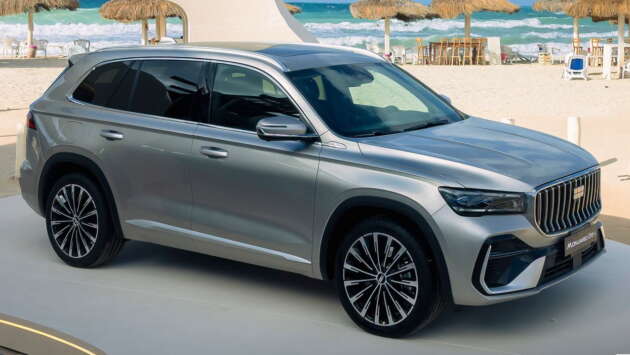
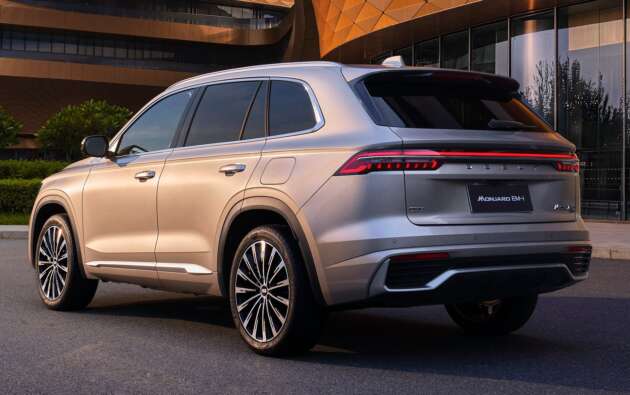
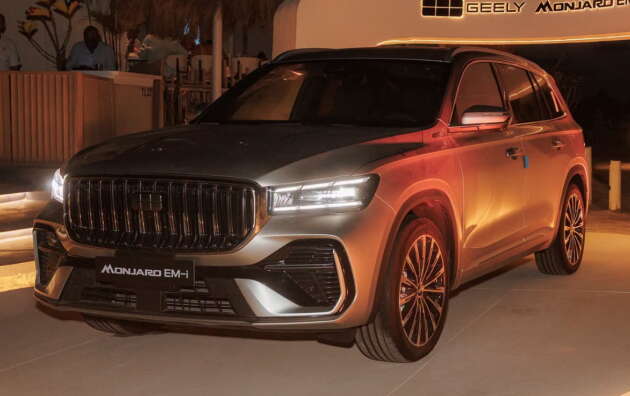
  • Geely Monjaro EM-i in Egypt – 1.5T PHEV with optional AWD, up to 340 PS, 667 Nm, 0-100 km/h 5.8 secs
    Geely Monjaro EM-i in Egypt – 1.5T PHEV with optional AWD, up to 340 PS, 667 Nm, 0-100 km/h 5.8 secs

    Having been revealed last week, the Geely Monjaro EM-i has gone on sale in Egypt, the car’s first market. With that comes more details of the plug-in hybrid D-segment SUV, which is set to enter global markets such as Australia, Europe and the UK later on.

    The E-Motive Intelligence (EM-i) powertrain has been upgraded from the one in the Starray EM-i (known to you and me as the Proton eMas 7 PHEV). The 1.5 litre BHE15 four-cylinder engine gains a turbo, similar to the one in the Chinese-market Xingyue L i-HEV hybrid. Outputs are down 19 PS and 25 Nm of torque at 144 PS and 230 Nm, which importantly is still 45 PS and a whopping 70 Nm more than the naturally-aspirated version.

    In effect, the Monjaro EM-i is a big-battery version of the Xingyue L i-HEV – itself a PHEV with a small battery. The force-fed engine helps juice an electric motor that is less powerful than the one in the i-HEV (55 PS less, in fact, at 163 PS) but with much more torque (81 Nm more at 343 Nm), resulting in a total system output of 277 PS and 544 Nm.

    Geely Monjaro EM-i in Egypt – 1.5T PHEV with optional AWD, up to 340 PS, 667 Nm, 0-100 km/h 5.8 secs

    The number of speeds in the dedicated hybrid transmission (DHT) isn’t known, but we assume it’s the usual EM-i single-speed unit. So equipped, the Monjaro EM-i is able to sprint from zero to 100 km/h in 7.7 seconds on its way to a top speed of 200 km/h.

    As previously reported, the Monjaro EM-i can also be had with all-wheel drive, with a rear induction motor boosting electric outputs to 272 PS and 493 Nm. Add the turbo mill to the mix and you’re looking at a combined 340 PS and a whopping 667 Nm, getting this two-tonne leviathan to 100 km/h in 5.8 seconds. Oddly, the top speed is slightly lower at 190 km/h.

    The battery options are identical to the Starray EM-i, with front-wheel-drive models getting an 18.4 kWh CATL LFP pack, delivering a pure electric range of 92 km. This gets boosted to 130 km on the AWD model thanks to a larger 29.8 kWh Aegis short blade unit. These figures are on the outdated NEDC cycle; expect closer to 80 km and 110 km respectively on the WLTP cycle.

    Geely Monjaro EM-i in Egypt – 1.5T PHEV with optional AWD, up to 340 PS, 667 Nm, 0-100 km/h 5.8 secs

    As for charging, the 18.4 kWh models support up to 38 kW of DC fast charging, topping up the battery from 30 to 80% in 20 minutes. The AWD version goes up to 78 kW and can charge to the same benchmark in 15 minutes. All models can accept 6.6 kW of AC charging, with the FWD models taking three hours to get from 20 to 100%, and the AWD taking 4.2 hours.

    The design of the car is as per the Xingyue L i-HEV, featuring a new bumper with twin silver “tusks”, a vertically-slatted grille and a rear bumper with large fake vents. The multi-spoke alloy wheels, meanwhile, were lifted from the Galaxy M7 and measure 20 inches in diameter.

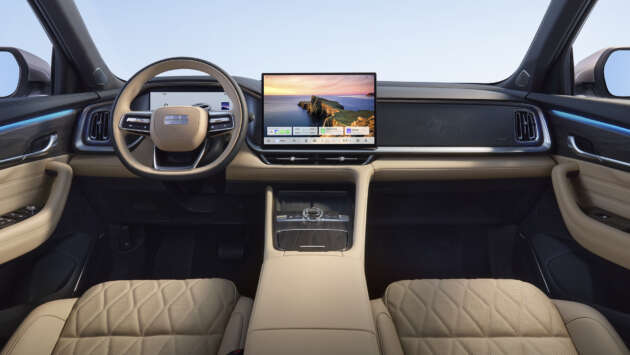
    Inside, the Monjaro EM-i has been completely redesigned and adopts elements from Geely’s newer EVs and PHEVs, such as the EX5 (i.e. the Proton eMas 7) and the Starray EM-i.

    Geely Monjaro EM-i in Egypt – 1.5T PHEV with optional AWD, up to 340 PS, 667 Nm, 0-100 km/h 5.8 secs

    It does feel a step up from the norm, however, with a steering wheel from the Galaxy M9, a stitched dashboard and door cards and lashings of wood and metal-look trim. As is typical for a Chinese car, large 12.3-inch instrument, 25.6-inch head-up and 15.4-inch infotainment displays feature (no passenger screen here, unlike the ICE model), as do smartphone holders, a 50-watt Qi wireless charger and a 16-speaker Flyme Audio sound system.

    The asymmetric centre console houses the usual multifunction rotary control knob, and in a refreshing departure from most Geely models, there are physical temperature toggles for the air-con. You also get quilted seats and a passenger dash panel with a mountain motif that references the car’s name (itself a nod to Mount Kilimanjaro, the highest mountain in Africa).

     
  • Malaysian fuel prices Sept 3 to 9, 2026 – prices down; diesel to RM4.67, RON95 to RM3.77, RON97 to RM4.25

    Malaysian fuel prices Sept 3 to 9, 2026 – prices down; diesel to RM4.67, RON95 to RM3.77, RON97 to RM4.25

    Being Wednesday, it’s time once again for the weekly fuel price update, with the finance ministry having announce fuel prices for the coming week of September 3 to 9. with that for both petrol and diesel fuels cheaper than last week.

    First up, the price of unsubsidised B10/B15 diesel. The fuel will be priced at RM4.67 per litre, down five sen from the RM4.72 per litre price it was at last week. This means that Euro 5 B7 diesel, which costs 20 sen per litre more than B10/B15, is now priced at RM4.87 per litre.

    Of course, as of July 1, Malaysians owning a diesel vehicle pay a subsidised retail price of RM2.10 per litre for B10 and B15 diesel blends, with eligible users now allocated a monthly quota of 300 litres as of September 1, still shared with Budi95 (which means the increase from 200 to 300 litres applies to both fuels). Private diesel pick-up truck and jeep owners can apply for an additional 100 litres of subsidised diesel per month, bringing the total monthly quota to 400 litres for them.

    Malaysian fuel prices Sept 3 to 9, 2026 – prices down; diesel to RM4.67, RON95 to RM3.77, RON97 to RM4.25Malaysian fuel prices Sept 3 to 9, 2026 – prices down; diesel to RM4.67, RON95 to RM3.77, RON97 to RM4.25

    As for the price of unsubsidised RON 95, a five sen reduction brings the price down to RM3.77 per litre from the RM3.82 per litre it was at last week, while the price of RON 97 petrol has also gone down by five sen to RM4.25 per litre (RM4.30 per litre last week).

    Meanwhile, subsidised RON 95 petrol under the Budi Madani RON 95 (Budi95) scheme continues at RM1.99 per litre, with Malaysians holding a valid driving licence being eligible for the fuel at a monthly quota that has now been restored to 300 litres as of September 1.

    These prices take effect from midnight tonight until Wednesday, September 9, 2026. This is the 37th edition of the weekly fuel pricing format for 2026, and the 400th in total since the format was introduced at the start of 2019.

     
  • Honda Malaysia September 2026 promo – up to RM12k off; WR-V, HR-V, CR-V, Civic and City Hatchback included

    Honda Malaysia September 2026 promo – up to RM12k off; WR-V, HR-V, CR-V, Civic and City Hatchback included

    Some are saying that now is the best time to buy a car, due to the competitive market. Well, Honda Malaysia’s eye-catching rebates are certainly backing that up.

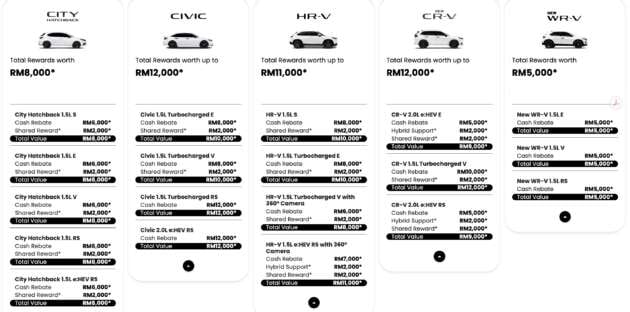
    The company’s ‘One Spirit, More To Celebrate’ promo for this month is offering up to RM12,000 in cash rebates. And that’s the official discount from Honda Malaysia; we’ve seen higher figures in ads by SAs, so do your homework.

    Surprisingly, the e:N1 a.k.a. ‘HR-V EV’- with its RM34,000 discount – disappeared from the list last month, so they’re all accounted for.

    What’s left are HM’s bread and butter CKD models made in 2026, except for the City. Looks like Honda has managed to successfully clear stock before the facelift arrives (debut this week). The City Hatchback is here though, and all five variants get RM8,000 off.

    Honda Malaysia September 2026 promo – up to RM12k off; WR-V, HR-V, CR-V, Civic and City Hatchback included

    Click to enlarge

    If you prefer (who doesn’t?), and have budget (not all, unfortunately) for the Civic, the still-so-desirable FE comes with a September discount of RM10,000 for the E and V variants, and RM12,000 for the RS petrol and RS e:HEV.

    Kicking off things for Honda’s SUV family is the WR-V, which has a RM5,000 rebate for all three variants. Yup, there’s now just three variants instead of four in a just-announced minor revision, which brings new kit and lower prices.

    The HR-V’s S and E get RM10,000 off this month, but opt for the V with 360 camera and it’s ‘just’ RM8,000. If you want the e:HEV RS, the 360 camera variant gets RM11,000 off.

    Finally, CR-V buyers will get either RM9,000 off for the hybrid variants (e:HEV E, e:HEV RS) or RM12,000 off for the pure petrol V spec. These discounts are for vehicles registered from now till September 30. The recently-launched RM278k Prelude isn’t in the list, of course.

     
  • Polestar 4 SUV debuts – up to 544 PS, 686 Nm, 630 km WLTP EV range; more practical; built in South Korea

    Polestar 4 SUV debuts – up to 544 PS, 686 Nm, 630 km WLTP EV range; more practical; built in South Korea

    The Polestar 4 SUV makes its debut as the more practical version of the Polestar 4, the latter first revealed over three years ago. Appearing more like a lifted estate, the 4 SUV is built in Busan, South Korea, with deliveries set to commence in the fourth quarter of this year.

    The visual link to the 4 is highly apparent, with the 4 SUV sporting the same front and rear fascias, sculpted sides, exterior lighting design and interior as its “SUV coupe” sibling. A stretched roof and a more upright tailgate are what set the two apart, with the 4 SUV offering more boot space as a result.

    According to Polestar, the 4 SUV with its 60:40 split-folding rear seats in their default position has 530 litres of boot space available up to the parcel shelf, or 655 litres when measured up to the inner roof. With the seats down, this expands to 1,665 litres of space. By comparison, the 4 offers 526 litres and up to 1,536 litres with the rear seats folded down. Both cars come with a frunk for an additional 15 litres of storage space.

    Because the 4 has a solid panel residing when a glass window would normally be at the rear of a vehicle, there is a display in the position of the rear-view mirror to show a video feed from a roof-mounted camera pointed rearwards. This is not the case with the 4 SUV, which gets a conventional rear-view mirror, although customers can option a digital rear-view mirror if they need wider field of view or unobstructed visibility when the car is loaded up to the ceiling.

    Polestar 4 SUV debuts – up to 544 PS, 686 Nm, 630 km WLTP EV range; more practical; built in South Korea

    Polestar also points out that the second-row seats in the 4 SUV are different from the 4, with the ones in the former being more upright to offer an extra 2.5 cm of headroom. For that airy feeling, there’s also a larger panoramic glass roof that stretches all the way back to the tailgate. This comes with 99.5% UV protection and for a little extra, it can be swapped for an electrochromic system with dimmable laminated glass.

    Given the shared Sustainable Experience Architecture (SEA), the 4 SUV gets the same powertrain configurations as the 4. The base option is called the ‘Rear motor’ and features an electric motor rated at 272 PS (268 hp or 200 kW) and 343 Nm of torque, while the higher-spec ‘Dual motor’ adds a second electric motor at the front for a total system output of 544 PS (536 hp or 400 kW) and 686 Nm.

    With more power, the Dual motor needs just 3.9 seconds to get from 0-100 km/h, while it is 7.3 seconds for the Rear motor. A 100-kWh battery pack is standard across the line-up, providing either 630 km (Rear motor) or 600 km (Dual motor) of range following the WLTP standard.

    In terms of charging, the 4 SUV supports DC inputs of up to 200 kW that will get the battery from a 10-80% state of charge (SoC) in 30 minutes. AC charging is at 22 kW, with a 0-100% SoC achieved in 5.5 hours, although this won’t be offered everywhere as selected markets will have to make do with an inferior 11-kW onboard AC charger. The 4 SUV also comes with a vehicle-to-load (V2L) system rated at 16 amps and 230 volts for up to 3.3 kW of power output.

    Interior amenities touted include an optional Harman Kardon Premium Sound system with 12 speakers and 1,400 watts of amplification as well as a Google built-in infotainment system with Gemini integration. Polestar says you can tell a Dual motor from a Rear motor by the former’s golden stripe on the seatbelt and media control rotary knob – the latter gets an all-black cabin.

    For more gold, the optional Performance pack adds a gold-finished rotary knob and seatbelts, along with recalibrated active dampers from ZF, gold-painted Brembo brake callipers and 22-inch wheels wrapped with Pirelli P Zero performance tyres.


Sell your car for a higher price, get paid in 24 hours

Latest Fuel Prices

PETROL
BUDI 95 RM1.99
RON 95 RM3.82 (+0.05)
RON 97 RM4.30 (+0.05)
RON 100 RM6.35
VPR RM6.98
DIESEL
BUDI RM2.10
EURO 5 B10 RM4.72 (+0.05)
EURO 5 B7 RM4.92 (+0.05)
Last Updated Aug 27, 2026
Fuel price history →

Tools


Related PaulTan.org Content: Petrol Price Hike A Hoax | Rafidah Instructed To Reply Dr M | The New 2006 Mercedes Benz S Class | Sime Darby To Take Stake In Proton | Proton Savvy Accident | Ap Permit Figures