Five years is a long time to wait for a facelift, but that’s exactly how long the second-generation Lexus NX has remained unchanged since its 2021 debut. Thankfully, the compact executive SUV has finally been given a makeover, slated to reach global markets at the end of the year – and it’s a big one, taking plenty of inspiration from the new ES sedan.
Rather than being a simple refresh, Lexus has taken a root and branch approach to overhauling the car’s underpinnings while maintaining its shape. New floor crossmembers and a stiffer transmission tunnel work together with the strengthened front and rear ends to boost floor rigidity by 25%, while the redesigned suspension towers are 30% stiffer.
These changes go hand-in-hand with the revised powertrain lineup. The NX is now hybrid-only with the elimination of the pure petrol variants, and the electrified versions that remain receive Lexus’ sixth-generation hybrid with the power control unit (PCU) integrated into the motor and E-CVT planetary gearset.
As such, the whole system is now 10 kg lighter and 10 cm slimmer, while the inverter’s silicon carbide semiconductors reduce energy losses to improve fuel efficiency, battery output and other aspects. Updated battery power management uses more electricity under acceleration to reduce engine speeds, allowing the revs to rise more in sync with the car’s speed to provide a more linear acceleration feel.
The range starts with a new NX300h, utilising a 150 PS 2.0 litre M20A-FXS naturally-aspirated four-cylinder engine for a total system output of 197 PS. This is the same powertrain used in the UX300h, as well as the top-spec Toyota Prius.
Move up one rung and you’ll get the NX350h, continuing to utilise a 184 PS 2.5 litre A25A-FXS NA engine (plus an additional rear motor for optional all-wheel drive) for a total output of 245 PS. The new lithium-ion battery, similar to the one in the ES350h, gets enhanced cooling that enables the number of cells to be reduced while maintaining output. As such, the pack is now 9.2 kg lighter at 23.5 kg, with the revised componentry also slashing the zero-to-100 km/h time by over half a second to 7.1 seconds.

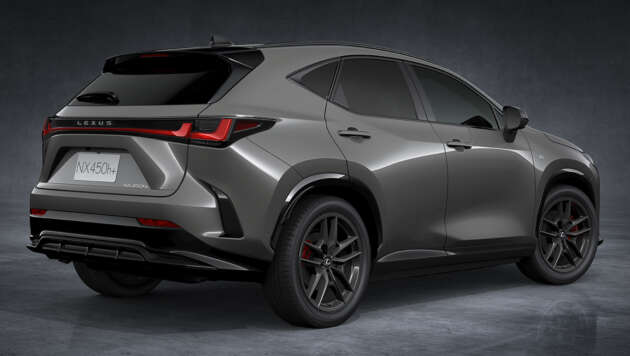
But it’s the NX450h+ plug-in hybrid that has received the biggest changes. It still uses the 2.5 litre mill and a dual-motor AWD setup (the front-drive version has been dropped), but the new battery provides an eight per cent power bump to 326 PS, marginally cutting the century sprint time to six seconds flat.
It’s more than just performance that has improved – that new battery has also had its capacity boosted by 30%, resulting in a near 30 km jump in pure electric range to over 100 km on the WLTP cycle. It’s also mounted lower under the floor for a lower centre of gravity, and the cells are aligned longitudinally instead of transversely to increase lateral rigidity.
The big news, however, is the inclusion of DC fast charging support to significantly reduce charging times. This has necessitated a move of the charge port from the rear to the front (on the same side as the fuel filler, nice), and you now get a powered port door.
Road manners have been improved with revised passive dampers (the optional adaptive items are unchanged), featuring ultra-low-speed valves for more responsive damping even for minute suspension movements. This provides a flatter, more refined ride over undulations, benefitting both ride comfort and handling. More responsive variable-ratio steering is also now standard, with the EPS retuned to suit.
The NX will also now apply the brakes subtly in the corners to quickly stabilise yaw and roll movements during abrupt manoeuvres such as sudden lane changes. Meanwhile, the throttle control and even the pedal assembly itself have been tweaked for a more linear response. Aiding refinement is a redesigned engine block and a more rigid connection between the engine and transaxle, moving resonance away from the engine’s combustion frequencies.
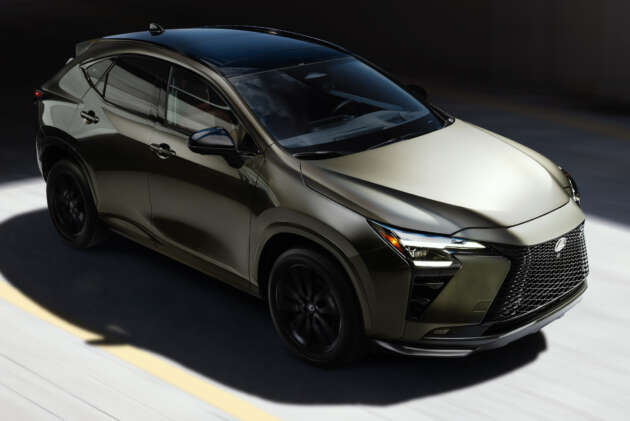
All those changes are belied by an exterior that remains recognisable as an NX, although there are a fair few revisions. The spindle grille has been retained, coming in a black finish that means the car still looks like a Lexus, instead of the rather anonymous body-coloured version used on recent models like the ES, TX and TZ.

The mesh grille is now integrated with the sharp L-shaped headlights (now with dual-line daytime running lights and indicators) for a sportier look. Those lamps flow into the more rigid ducts that stabilise airflow around the front tyres to improve handling stability, while wheel house fins evacuate more air out to reduce pressure buildup, lowering rear-end lift.
The side and rear are mostly unchanged, still with the fiddly electronic door pulls, sculpted flanks and the Lexus script at the back. The latter is now illuminated in concert with the full-width taillights, which feature a dual-L signature for the first time on a Lexus.
Inside is where the NX looks the most like the new car. Gone is the sculptural dashboard, replaced by a simple horizontal piece inspired by the ES. That includes the hidden-until-lit capacitive touch air-con controls (boo) that replace the physical knobs built into the touchscreen, although haptic feedback provides a modicum of usability.

Speaking of the touchscreen, you still get a 14-inch panel for the infotainment, although the dispensing of those knobs means you should get more real estate back. The instrument display measures 12.3 inches, sitting behind a smaller steering wheel (also with hidden controls) with more reach adjustment for a better driving position. The redesigned centre console comes with a stubby gear selector toggle and increased storage.
You can still get the NX with Lexus’ trademark Mark Levinson sound system, now featuring metal speaker grilles and rather crass ring lights that correspond with the ambient lighting. The latter forms part of a new Sensory Concierge that coordinates lighting, music, air-con, seat temperature and a new air fragrancing system (with five scents available to fit in the three cartridges) according to three “moods” – Inspire, Radiance and Revitalise.
The NX can now be had with two new exterior colours – Sonic Tellus (an ashy green) and an F Sport-exclusive Titanium Carbide Grey. Inside, there’s a new Mars-inspired Abalos (brown) and a searingly red Prominence, the latter again only on the F Sport.

Safety-wise, the NX inherits the latest fourth-generation Lexus Safety Sense+, equipped with improved autonomous emergency braking with a higher speed range, plus smoother adaptive cruise control and auto lane changes. The cruise control now has an Eco mode that works with the navigation for more efficient throttle application.
There’s also a new camera based driver attention monitor that can pull over and stop the car if it senses the driver is incapacitated, as well as improved lane keeping assist that can detect poles and barriers if road edge markings are unclear. Blind spot monitoring now detects motorcycles and bicycles, while improved adaptive high beam and a new 360-degree camera system with 3D and transparency views are also fitted.