
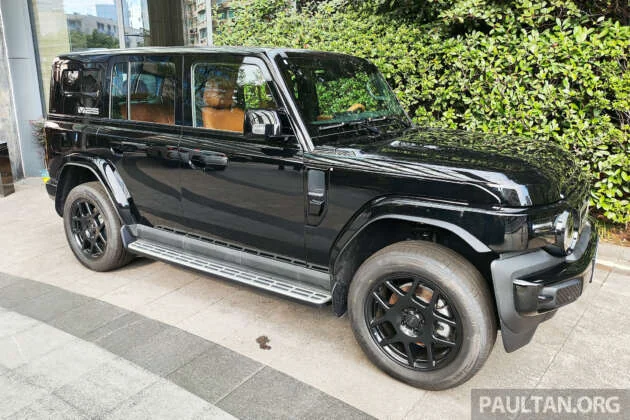
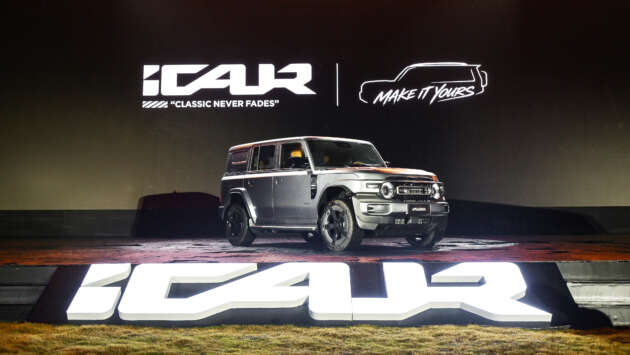
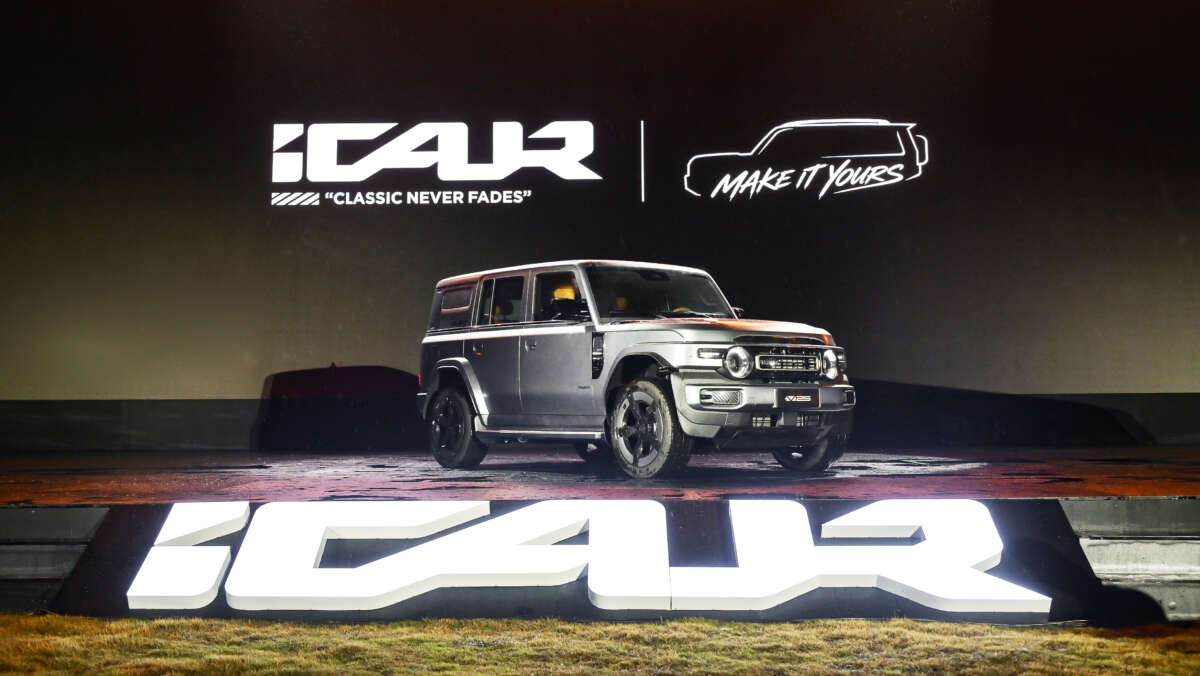
Revealed in August, the global iCaur V25 has made its first live appearance at the recent iCaur International User Summit, held alongside Chery’s multitude of other brands. Essentially a stretched V23, this new energy SUV splits the difference between its smaller sibling and the V27, completing the retro-styled V-Series lineup.
It’s also the best of both worlds under the bonnet, because this will be the first iCaur to be offered as both a battery EV and a range-extended EV. This differs from China, where the V25 is sold purely as an REEV.
Still not much is known so far, apart from the fact that the dual-motor all-wheel-drive version will have a combined output of 455 PS (335 kW) and 505 Nm of torque, the same as the V27. Oddly, the petrol engine – likely the same 1.5 litre turbo four-cylinder as the V27 – has a slightly lower claimed thermal efficiency of 44.5% (versus the V27’s 45.79%), even though it produces the same 3.71 kWh per litre of fuel.
We know rather more of the Chinese-spec model, which has just gone on sale. There, the car is available in rear- and all-wheel-drive REEV variants, with the former being obviously less powerful at 252 PS (185 kW) and 300 Nm. In the Middle Kingdom, the petrol generator retains the V27’s 45.79% thermal efficiency and makes 156 PS (115 kW) and 220 Nm.
All REEV models get a 33.67 kWh Gotion LFP battery that delivers an EV range of 210 km for the RWD model and 200 km with AWD, both on the CLTC cycle (expect around 170 km and 160 km respectively on the WLTP cycle) and a total range of 1,240 km (1,210 km with AWD) with the 58 litre fuel tank included. With support for up to 90 kW of DC fast charging, the pack can be topped up from 30 to 80% in just 15 minutes.
Measuring 4,636 mm long, 1,920 mm wide and 1,855 mm tall, the V25 is a massive 416 mm longer, five millimetres wider and ten millimetres taller than the V23, with 85 mm of that extra length going to the 2,820 mm wheelbase. Against the V27, the car is 419 mm shorter, 56 mm narrower and 39 mm lower, while its wheelbase is 90 mm shorter.
iCaur says the V25 uses a cage-like body structure that utilises 80% high-strength and advanced high-strength steels, with a torsional stiffness of 30,000 Nm per degree. It will also have a towing capacity of 1,800 kg and add a centre airbag to the V23’s six airbags.
While being obviously derived from the V23, the V25’s longer rear overhang gives it a boxier look more in keeping with the car’s pseudo off-roader aesthetic. There are also some unique touches such as the headlights, which gain thicker round instead of linear daytime running lights, as well as a more open grille with a rectangular insert; the latter appears to be exclusive to the REEV version.
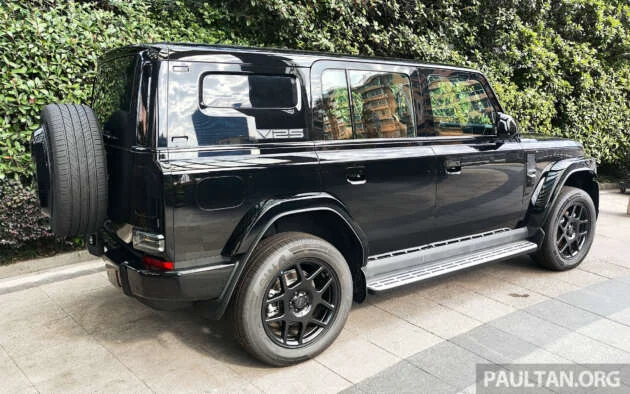
At the rear, the blind spot-inducing rear quarter panels feature a rectangular pressing, presumably to fit accessories. These likely form part of the 20 “native modification interfaces” that allow users to customise and modify their cars as they see fit. The rear number plate recess has also been pushed down from the tailgate into the bumper.
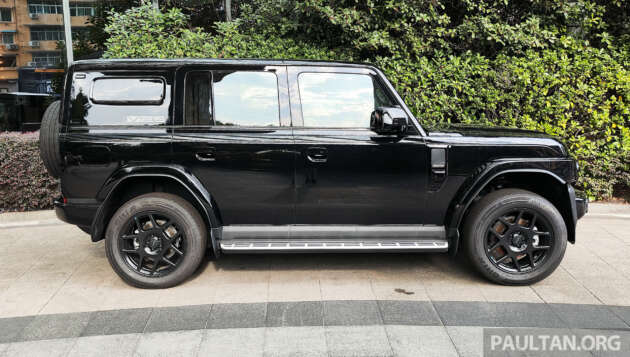


That change was made to accommodate a full-sized spare tyre, taking the place of the Chinese market’s storage backpack; a vertical handle for the sideways-opening back door has also sprouted. Speaking of tyres, the debut V25 example looks to wear Goodyear Eagle F1 rubber on its largest 21-inch wheel option, instead of the V23’s budget Chaoyang Radial RP76+ hoops, but GitiControl P10 units also look to be standard fit, as shown by the 255/55 19-inch units on the static display example seen here.
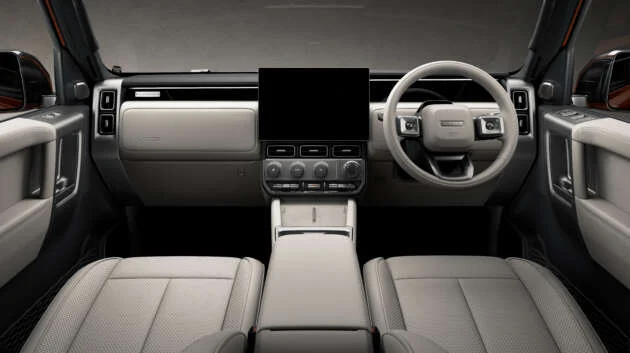
Not much has changed on the inside, where the V25 retains the V23’s rectilinear design, metal-look trim, chunky switchgear and 15.4-inch infotainment touchscreen. Usability tweaks include an actual eight-inch instrument display, increased physical switchgear and a new centre console with twin phone holders and – finally! – a 50-watt Qi wireless charger.
Other new features include a panoramic sunroof with a built-in sunshade, heated and ventilated front seats with driver’s side memory and a 15-speaker Pioneer sound system. The V25 also offers the usual Level 2 semi-autonomous driving functions such as autonomous emergency braking, adaptive cruise control, blind spot monitoring, driver attention monitoring and park assist, plus a 360-degree camera system with transparency.
The increased dimensions has had an effect on the rear accommodation, which not only offers more legroom but also enough width to fit a proper sliding and reclining bench for three-abreast seating. The V23’s rear seats were very much designed for two, even though there was a centre seat belt installed seemingly almost as an afterthought. With more space, the front seats can be reclined completely flat to serve as beds.
The V25 also offers 41 storage compartments and 378 litres of boot space (versus just 234 litres for the V23), expandable to 998 litres (V23 744 litres) with the rear seats folded. Fully-electric models gain 22 litres of underfloor storage and, unlike the V23, a front boot of an unknown capacity. You also get a 6 kW V2L function.
As for availability, the V25 will be rolled out globally starting early 2027, with the car set to be the first iCaur to be sold in Australia. Already spotted testing in Malaysia, it will likely arrive shortly after, with the brand currently busy readying the V27 for our market.
GALLERY: iCaur V25, static display in Wuhu, China


GALLERY: iCaur V25, official images




 iCaur V23
from RM132,780
 iCaur 03
from RM119,740


Another comfortable beast, the iCaur V25, was spotted road-testing in Malaysia in August.
That’s way before iCar’s yesterday soft launch, pre-sale booking in its homeland, China.
The Chinese really don’t have any idea and can’t decide what to name their cars.
still a better name than random numbers, bmw 123i mercedes 456e