

Geely appears to be mounting an almighty assault on the Australian market, after kicking things off with the EX5 (known to you and me as the Proton eMas 7) and Starray EM-i (Proton eMas 7 PHEV). The appropriately-named Battleship 700 – no Galaxy sub-brand for global markets – will join the Emgrand L EM-i and Monjaro EM-i in the second half of 2027.
The country gets the most potent version of the boxy plug-in hybrid SUV – a triple-motor setup that produce 313 PS and 350 Nm of torque at the front and 598 PS and 620 Nm at the rear. Couple that with the 218 PS/360 Nm 2.0 litre turbo four-cylinder and a three-speed dedicated hybrid transmission (DHT) and you’re looking at a total of 1,128 PS and 1,330 Nm (!).
Despite the Battleship weighing a rather hefty 2,705 kg, it’ll sprint from zero to 100 km/h in a barely believable 3.95 seconds on its way to a top speed of 220 km/h. A 47 kWh Aegis short blade LFP battery – guarded by six layers of underbody protection – delivers a claimed pure electric range of 170 km on the WLTP cycle.

The Australian release is light on the details, but we can turn to the Chinese-market model, which has only recently been launched. The Battleship is built on a dedicated Geely Terrain Architecture (GTA) that combines a monocoque construction with an integrated ladder frame, with the passenger cell being made from 100% ultra-high-strength and hot-formed steel.
It’s an absolute beast, measuring 5,085 mm long, 1,999 mm wide and 1,912 mm tall, with a 2,900 mm wheelbase. Despite this, the car is a strict five-seater, riding on double-wishbone front and independent five-link rear suspension.
Other features include a “waltz” U-turn function – more commonly known as a “tank turn” – as well as a mechanical locking rear differential, dual-chamber air suspension and a total of six off-road-specific drive modes. Maximum water wading depth is 800 mm, and there’s even a version of the car that with twin propellers that will be able to travel on water (like the Jetour G700), but that will likely remain a China exclusive.


Previewed by the Galaxy Cruiser concept at Auto Shanghai last year, the Battleship is a departure from Geely’s erstwhile sleek and minimalist design language. Instead, the Chinese conglomerate is jumping on the Defender and Ford Bronco-inspired pseudo-4×4 bandwagon that other such models like the Jetour T2 and Denza B8 have already hopped on.
The wide-set grille integrates the circular headlights said to be inspired by lion dance costumes, joined together by a light strip and an illuminated Geely Galaxy logo. The beefy front bumper houses what look like orange tow hooks, but the real ones are down below and painted black. There’s even a bonnet scoop.
Moving further back, the upright glasshouse, wraparound windscreen design, kinked window line, broad shoulders, chunky pull-type door handles, blistered squared-off wheel arches and tailgate-mounted spare tyre are typical for the class. Vertical “star matrix” taillights and 20-inch two-tone alloy wheels complete the look.
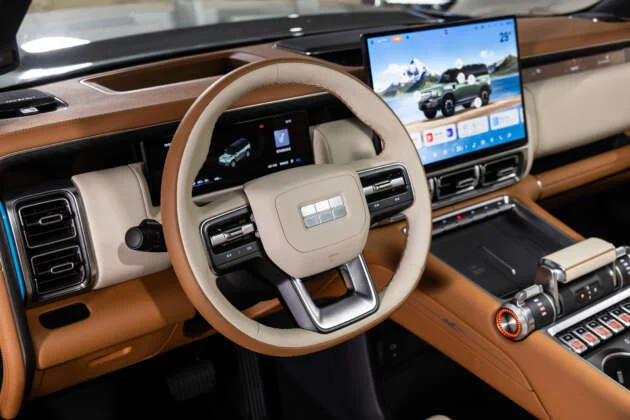
Inside, the Battleship continues the rectilinear theme with a horizontal dashboard design, vertical corner air-con vents, rectangular quad centre vents and a wide-set centre console housing an aeroplane throttle-style gear selector. The latter is flanked by drive mode toggles illuminated in orange, sitting ahead of crystalline buttons for various vehicular functions.
The tech onboard consists of a 10.2-inch instrument display and a 15.6-inch infotainment touchscreen, below which sits physical air-con controls (yay!). The Chinese-market display unit also gets an exceedingly slim 12.66-inch passenger readout, but this is unlikely to be offered elsewhere. Despite the car’s flagship status, Geely has only seen fit to include a single 50-watt Qi wireless charger, despite there being space for two.


Thankfully, Geely hasn’t cheapened out anywhere else. The Battleship comes with fully-reclining ten-layer front seats with ventilation and massage, a heated and cooled centre console fridge, triple-zone auto air con, a panoramic sunroof that opens all the way back to the rear seats, active noise cancellation and a 23-speaker Flyme Sound system, among others.
While right-hand drive Geely models are usually a precursor to Proton getting them to be sold here, something tells us that the Battleship won’t have the same fate. Prices in China range from 199,800 yuan (RM121,700) to 269,800 yuan (RM164,400), but as is usual for cars from the Middle Kingdom, they will likely be much more expensive once converted to right-hand drive, making it unsuitable for a Proton eMas vehicle. Still, imagine the possibilities…


Should bring over here and call it the X110
A dream alternative to Yangwang U8 and Chery Jetour Zongheng G700.
A modern flagship that can do proper jungle trekking and lake crossing for the full spec GT offroad lake diving grade, over a tonne of horsepower.
I really hope Geely will rebadge and CKD this to Proton E.Mas. As long the price of Battleship 700 top Spec AWD, is less than RM200k, they can find buyer for this model.
And indeed this model is really beautiful for big size SUV.
Proton and Geely please take note.
Below rm100k la