
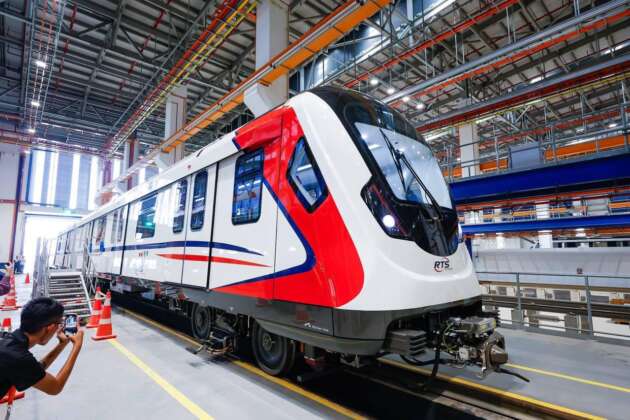
While ticket prices and the exact date of operation for the Johor Bahru-Singapore Rapid Transit System (RTS) Link have yet to be announced, competitive fares will be crucial to ensuring the new rail project attracts enough daily commuters, says an academic.
According to Universiti Teknologi Malaysia (UTM) department of urban and regional planning senior lecturer Safizahanin Mokhtar, fares for Malaysians commuting to Singapore should be competitive with existing cross-border transport options.
She said that the estimated pricing of between S$5 (RM15) and S$7 (RM22) indicated previously for a one-way RTS trip could make the service less competitive than existing alternatives, including buses, the KTM Shuttle Tebrau, taxis and e-hailing services, The Star reports.
“For Malaysian workers commuting to Singapore, a reasonable daily allocation would be around SGD7 to SGD9 (around RM22 to RM29) for a return trip, depending on their income, occupation and professional level,” she said. She said that presently, bus trips cost about SGD3.50 (RM11.30) to SGD5 (RM16.10), while the KTM Shuttle Tebrau fare is RM10.


She added that although the RTS would offer greater comfort and shorter travel times, higher fares could limit its appeal and use primarily to professionals and business travellers. “Lower-income and semi-skilled workers may continue to choose buses or private vehicles if the RTS fare is significantly higher,” she said.
Safizahanin said that higher ticket prices could result in a much smaller modal shift than projected, with only 150,000 to 180,000 daily users compared with the 300,000-user target, resulting in the rail project having less on an impact on reducing Causeway congestion. Should be this the case, the reduction in vehicles doing the border crossing would be estimated at only 10% to 15%, compared with 40% to 50% under an optimal fare structure.
She proposed a hybrid cost-recovery model, with fares covering about 65% to 75% of operating costs and the remaining 25% to 35% supported through government subsidies from both Malaysia and Singapore. She said an initial basic one-way fare of around SGD3.50 (RM11.30) to SGD4 (RM12.90), coupled with monthly passes and other fare structures, could help the RTS achieve a higher load factor and stabilise its financial operations as passenger numbers grow.
She said transport affordability studies generally suggested that fares should not exceed 5% to 8% of a user’s monthly income, while the World Bank’s transport affordability index placed the threshold at 10%.


malaysians better stay in own country to work . dont go to singapore which has buildings with inadequate facilities. at singapore none of the buildings dont even have prayer room . here every single commerical building , office, mall, condo, petrol station has that prayer room
Pray on the road lah sepuas puas . What’s the problem? Want air con ?
The research shows the persons knowledge on the matter is purely based on numbers and has zero understanding of dynamics on the ground. Did she mention that the tebrau express sells out the moment tickets open and it’s not a viable last minute or daily alternative or that the VEP costs Singkies are charging will rise in 2027 compounding to private bus and vehicle costs? These are factors never mentioned in the study just show how little these so called experts know about situations when they make a comment.
Fare comparison should be between bus and RTS from JB to Woodland North MRT station . It cost roughly SGD 1.40 after transfer rebate to travel from JB CIQ to Woodland North Station. Expert talking here .
malaysians need to stop thinking of the word “subsidy”