
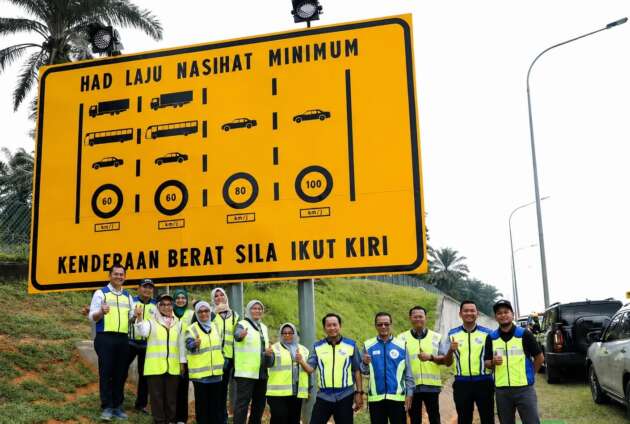
On August 1, the Malaysian institute of road safety research (MIROS), together with the Malaysian highway authority (LLM) and highway concessionaires PLUS and SKVE began running a proof-of-concept (POC) trial for an advisory minimum speed limit on three stretches of highways.
The idea behind the POC, which runs until October 31, is to see if motorists can move away from the practice of “lane hogging,” with the idea of inculcating the use of the correct lane being used for a certain speed. The intention is of course to keep traffic flowing smoothly and reduce the dangerous bottlenecks caused by vehicles travelling too slowly in the fast lane.
The five objectives listed by MIROS for this exercise are:
- Preventing lane monopolising (lane hogging)
- Reducing the speed difference between vehicles
- Increasing traffic capacity and flow
- Reducing the risk of dangerous lane changes
- Improving overall road safety
On these designated stretches, each lane gets a recommended minimum speed, displayed on signboards, and drivers are encouraged to travel at least at that pace for the lane they’re in, unless conditions don’t permit it, such as bad weather or very heavy traffic. If you want to cruise slowly, keep left; the further right you go, the faster you’re expected to flow.
The three pilot locations for the POC are:
- North-South Expressway (PLUS) E1: KM400.1 to KM388.0, northbound (Tanjung Malim–Behrang)
- SKVE E26: KM9.6 to KM16.7 (Ayer Hitam toll plaza–Bandar Saujana Putra)
- PLUS E2: KM267.8 to KM278.8, northbound (Bandar Ainsdale–Nilai)

During the trial period, drivers travelling on these stretches are encouraged to adhere to the advisory speed limits based on their lane usage, giving way to vehicles that wish to overtake. The suggested minimum speeds on these stretches are:
- Left lane: Minimum 60 km/h (ideal for cruising or slower-moving traffic)
- Middle lane: Minimum 80 km/h (or 60 km/h, depending on the number of lanes)
- Rightmost lane: Minimum 100 km/h (on three- to four-lane highways) or 80 km/h (on two-lane highways)
As this is a trial of guidance exercise, not a new enforceable speed floor, the speed suggestions at stretches for the POC is very much an advisory. As such, MIROS says that drivers should not feel obliged to meet the recommended speeds during:
- Heavy rain or poor visibility
- Traffic congestion or road accidents
- Road maintenance or lane closures
- Instructions from highway personnel or police
As road safety remains the top priority, motorists are reminded to maintain a safe following distance from other cars at all times.
We’ve explained why driving slowly on a highway, in the wrong lane, doesn’t make it safer for anyone – read our earlier story to find out why.


No maximum speed limit ?
mostly jammed during celebration weeks and/or school holidays, give you 300km/h pun your car will crawl at 20km/h. what is root cause of jam during these times? cars going into R&R and on certain pre-celebrations makan2 on road side with whole family becos die2 must eat full nasi lauk mangkuk tingkat before sunrise….
Nasihat? Better nasihat lorries not simply going into fast right lane because these are the culprits causing slow moving traffic on 2-lane Plus highway, damned lorries
you should actually question why 40 years after NSE was opened yet still some portions are 2 lanes only and not uggraded to more lanes. did the toll money collected to to feed m cronies?
We should have more ikut kiri kecuali memotong signature across the highway, two lanes and above. Cheers