

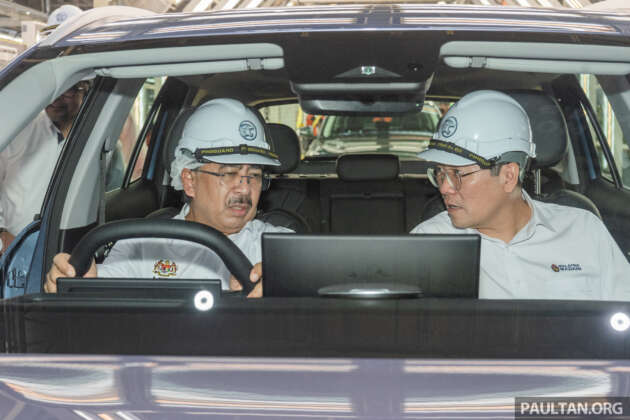
Malaysia’s investment, trade and industry (MITI) minister Datuk Seri Johari Abdul Ghani (left) revealed during Friday’s Proton eMas 7 PHEV CKD line-off ceremony that the country forwent RM3.3 billion in tax throughout the four-year fully-imported (CBU) EV tax holiday we enjoyed from 2022 to 2025.
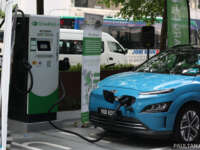
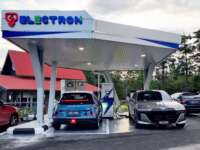
“For four years we let EVs be imported without charging import nor excise duties. The country’s total forgone tax was RM3.3 billion. We forwent this for four years, but there are not enough public chargers (to accommodate the increased EV volume).
“Some flats and condos don’t have chargers, and if (the residents) want to install AC chargers, Bomba will not approve, because (at the time) the building was built, the power supply was enough. Let’s say a condo has 500 units and each unit owns two cars, that’s 1,000. If everyone installs an AC charger, there wouldn’t be enough electricity (to cope),” he said.
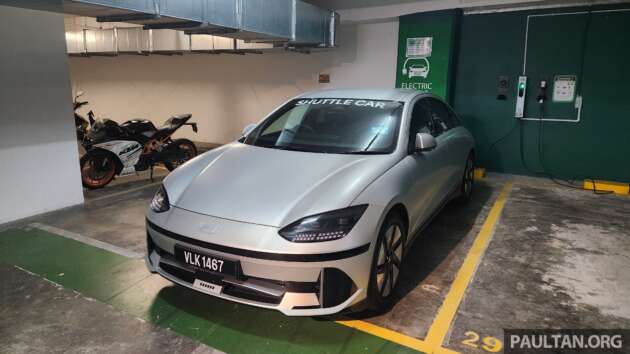
Johari added that discussions would be held with Tenaga Nasional (TNB) on building more substations so that more public chargers can be built.
“We’re not prohibiting EVs. EVs are the future. Hybrids are the future. But let’s not be early movers in the market only to create problems for the rakyat – ultimately, the government will also have to face these problems.
“I met China’s trade minister and asked him how EVs became so successful there. He said the Chinese government spent billions of dollars on public chargers. We, on the other hand, spent billions giving exemptions,” he said, adding that the CBU EV taxes collected by the government (since 2026 began) would be ploughed back into public charging infrastructure. The latest target is 30,000 chargers by 2030 – we’re now at 21%.





stop blaming on the government missed collected the 3.3b of tax due to the exemption give. Even with this tax collected, I doubt it will be any faster in getting it setup. First reduce the red tape in setting all these up. Too many approval from respective government bodies to implement charging point at site. Understand there is safety concerns and etc but it needs to be review to speed up the implementation to make the figure achievable.
Now let’s see them fail trying to build an EV infrastructure that’s entirely by government
Sape PM for 2023 until now?
That’s a bizarre take. Without the tax exemption, there wouldn’t even be much sale of EV vehicles during that time.
So why say Malaysia missed out on this?
BS again, as usual
1. How much fuel subsidies did govt save by having these EVs on the road?
2. Without these tax free incentives; would (A) the rakyat start the shift towards EV adoption.. and (B) the govt really spend Rm3.3b to build public chargers; or would the money to into cronies pockets and spending on stupid projects that benefits no one but their small cronies friends..?
3. With subsidies gone (except for their prodigal sons Proton and Perodua), would EV adoption continue at current rate..? Then back to point (1) above
The government didn’t spend RM 3.3 billion. It’s a missed opportunity and not direct spending. Knowing how our helang in the government spends money, that RM 3.3 billion, even if collected, would have just disappeared and benefited only a select few. TNB is obviously a GLC, and yet EV roadmap planning does not involve TNB and tasks TNB to come out with an expansion plan that is in line with the government objective, clearly showing how effective or ineffective our government operates.
Well, when oil was 90 dollars a barrel, the government spent RM3.5 billion a month subsidizing gasoline. The government could have clawed back four years of exemptions within a month. Even if we go back to “normal” crude oil prices, Malaysia is still spending billions a year on subsidizing a lot of waste. I’d like to see them explain how gasoline subsidies helped with infrastructure that applies to transportation. The exemptions were used to boost the uptake and kickstart the industry. It solves a chicken-and-egg problem, not an opportunity cost. Without the cars on the roads in the first place, no company would go build the network. And more importantly, the problem preventing more charge points from getting built was never about the money, but the insane amount of red tape, and then the considerations of capacity and safety. It really doesn’t help the energy equation when datacenter are competing for the same infrastructure.
Also, if you want to quote China and learn from them how to succeed in rolling out the whole system, you need to include as well how their government subsidized everything from raw material processing to components manufacturing to final assembly. Simply talking about “subsidizing charging infrastructure” only lets you solve a tiny sliver of a much more complex problem.
Classical problem of missing the forest for the trees.
The funny thing is they always never mention how much in fuel subsidies the government saved because people switched to EVs.
You can easily see where their priorities lie, when all they ever talk about is the amount in tax revenue the government missed out on.
It is like none of them have ever taken a single civics class when they were in school. The government’s job is not to maximized revenue extraction from the citizenry, but to improve the lives of people you are governing.
Dato Jo, as much as you listen to Miti officers information, it would be great if you could at least read/listen to the ideas from the normal rakyat.
You said here for 4 years, our country loss 3Billion.
To make it simple, let say 1 Billion loss on EV, per year.
I am very sure you know how much we are going to subsidize the petrol and diesel for rakyat this year.
Almost 30 Billion in one single year for diesel and petrol subsidy.
That 30 billion of fuel subsidy can be used to improve our schools, universities and public health care, public transportation, public EV chargers.
Even that 30 billion can be used to help the livelihood of the 80,000 men and women who’s going to “loss job” because of EV.
If more people drive EV without excise and duty tax, more government will save on petrol and diesel subsidy.
Please Dato Jo reconsider road map for EV in Malaysia.
The tax also come from rakyat.
Talked as if the foreign car manufacturer is the one paying the tax and by giving exemption, the RM3.3 billion did not flow into Malaysia.
It’s the us the Consumer that borne this high tax on cars, it’s us consumer that take up 9 years loan, pay interest to bank and give the money to you dumb asses!! There is no net inflow from outside the country, it’s just flow from consumer pocket and goes into your pocket (pun intended).
So? What are you both in MITI going to do about it? Goyang kaki?
All talk no action. Nothing new.
We safe on fuel subsidy lah dear Minister……that can off set the tax forgone.
Just a craps!
Who calculated that 3.3B?
U think Atto3, Seal 6 etc can sell well if priced rm250k & above?
Our minister is either too comfort in the seat thinking how to suck money from different tax or too dumb to know how economy works.
EV is always the priority when the gas fees are expensive in a long term. Its like we do not use newspaper because with the phone, you dont need people to deliver the bews to you 24 hours late.
We all know China has high volume of registered vehicle that left out in buildings lots just to boost the GDP sales image.
But as of now, when the people are getting the real price on what they deserve during the so called ” tax free ” , the government decided to end it just because they have mentioned the deadline before. Come on, the government dont even know when their project is going to be success but when it comes to tax, they suddenly know how it suppose to works?
New BMW EV’s have great range. Over 700km.not so sure about the weight. This makes having a EV more tolerable.
Nice story about China using billions to build chargers instead of cutting tax but it’s simply not true is it?
Subsidies in free registration of EVs, direct tax subsidies and exemptions to buyers and manufacturers, generous trade in rebates (governmental). There were a slew of deals side incentives.
To frame it as “Oh China spent billions to build chargers and Malaysia spent billions giving tax cuts je” is disingenuous and frankly insulting.
It is a chicken and egg thing. Without the tax rebate Tesla won’t be here and parallel imports of Model 3 weee going at ~450k instead of 160k. Who is going to use the chargers you spent billions building?
And moreover this is Malaysia, any government led rollout of EV chargers will be scandal, corruption infested undertaking. Give incentives, leave it to the private sector, please, I beg you.
Have some self respect don’t beg
Thank you for the info Miti but
… Served you right with flip flop policies.
If Govt really serious about EV, they should be one the lead the transition to the green energy. Not just half cook plan and dumping everything on the rakyat and hoping for the plan to take off on it own.
And claim credit for it if the plan success.
Now back to reality they just try to solve and fix the problems that they have created in the first place. Lol
Why tax in the first place?
“I met China’s trade minister and asked him how EVs became so successful there. He said the Chinese government spent billions of dollars on public chargers. We, on the other hand, spent billions giving exemptions,”
What is he even talking about?
Government spent billions giving exemptions? When you tax you are taking monies from Rakyat, the tax is not pay by the car companies.
Why dont change your mindset by making Malaysia real EV manufacturing hub by leveling the field for all brands, compete with exporting nations collect reasonable tax from export?
What’s next. Not enough petrol station or car workshops hence need to tax more also right
Why do we elect fucking morons to positions of power?