

The government has announced that the issue of cellular dead zones on certain stretches of Malaysian highways will be addressed with the construction of telecommunications towers. According to works minister Datuk Seri Alexander Nanta Linggi, 77 such towers will be put up along 50 km of highway stretches that have been identified as having poor mobile coverage.
Speaking at a MoU exchange ceremony between the Malaysian communications and multimedia commission (MCMC) and the Malaysian highway authority (MHA), he said that MCMC is targeting the construction of these telco towers, with the initiative being carried out with the use of highway reserve land, or Right of Way (ROW), for communications infrastructure.
Communications minister Datuk Seri Fahmi Fadzil, who was also present at the signing ceremony, said MCMC had issued a tender on May 15 to improve internet coverage through the construction of telecommunications towers along 10 MHA-managed highways with weak connectivity, the New Straits Times reports.
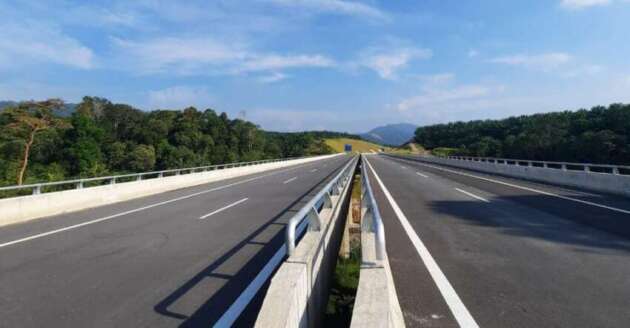
The initiative is expected to enhance road safety and convenience by addressing weak coverage areas, or blind spots, that frequently result in dropped calls on the targeted highways, which include the East Coast expressway 2 (LPT2), the West Coast expressway (WCE), and also geographically challenging locations such as the Menora Tunnel and Gua Tempurung along the North-South Expressway (NSE).
Fahmi said the MoU would also strengthen the country’s digital infrastructure to support future mobility technologies such as the multi-lane fast flow (MLFF) toll collection system and intelligent transport systems (ITS), both of which require stable and reliable network connectivity.
The collaboration between the communications ministry and the works ministry aims to improve communications access for motorists throughout their journeys, including that for emergency communications, navigation services, real-time traffic information and other digital services.


Just fire comunication minister too. Useless makan gaji buta, he thinks his job is just to install telco towers!
Very good! but how bout those housing areas? and some other kampung or rural areas!? We are not even talking bout Borneo yet, even in so call “TANAH MELAYU” also not fully coverage, always no line in some certain area!
the solution is to climb tree to get better signal .
source – Veveonah Mosibin, a Sabahan student from Kampung Sapatalang, Pitas, who camped out on a tree in June 2020 to catch a stable internet signal for her university online exams.
wait a minute, are you implying borneo isnt part of tanah melayu?
must give contract to cronies so they can live like a god
I thought they claimed we have really high coverage of 5G? goreng lah as usual.
the problem is that malaysian gomen decommisioned 2g and 3g in order to reuse those frequency for 5g .so as of today 5g coverage is good in urban areas but 3g which was formerly available in rural areas had been removed.
correct me if wrong thats my understanding .
Only 3G got stop,
2G works fine because rural area can be reach by 2G easily unlike 4G and 5G
2G 50KM radius from tower
4G 25KM radius from tower
5G 10KM radius from tower
Only LPT2? Lingkaran tengah&LPT 1 coverage masih teruk berbanding LPT 2. 5g mostly on west coast and south. From Kuala Lipis to Kuala Krai phone connection always drop to nothing