
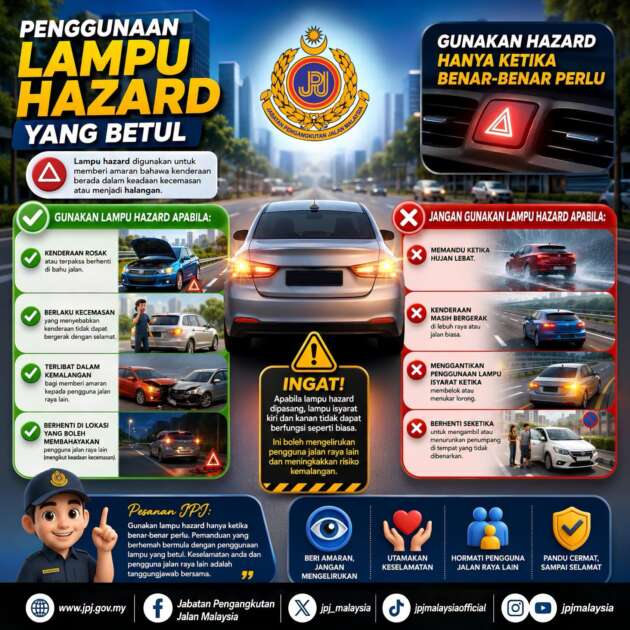
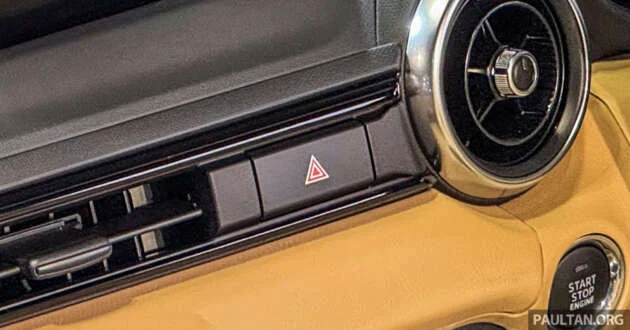
Here goes the road transport department (JPJ) again with another public reminder, this time to do with hazard lights. Colloquially known in Malaysia as ‘danger lights’, ’emergency lights’ or ‘double signals’, this feature, activated usually by pushing a button with a white double triangle on a bright red background, still sees its fair share of misuse among drivers.
The primary job of hazard lights is to warn other motorists of, well, hazards. Like a stationary (not parked) vehicle. If your vehicle has broken down and is stranded by the roadside or is involved in an accident that’s rendered it immovable, you turn the hazard lights on to draw attention and make yourself more visible. This lowers the risk of you getting hit by other vehicles inadvertently.
Hazard lights are to be used only when the vehicle is stationary. They may not be used when the vehicle is moving (we’re looking at you, wedding convoys), including when driving in the rain. This is because when the hazard lights are on, your directional indicators (turn signals) do not work, so other motorists will know nothing about your intentions. The increased danger as a result of this far outweighs the perceived higher visibility that comes from using hazard lights in the rain.
JPJ also says hazard lights are not to be used when “berhenti seketika untuk mengambil atau menurunkan penumpang” (stopping briefly to pick up or drop off passengers), which has us scratching our heads a bit, but perhaps the “di tempat yang tidak dibenarkan” (where it is not allowed) proviso that follows suggests that one should not do that in the first place, hazard lights or not. And of course, the Japanese practice of flashing one’s hazards twice as a thank you gesture is not officially in the Malaysian highway code.


Tell that to st*pid PDRM. Sirens on, blue light on, hazard light pun on kena ON ka?
some car manufacturers when emergency brake, the hazard lights will turn on by itself.
JPJ has not learned from years of experience that in very heavy rain visibility is very poor and slow vehicles are a danger to road users.
I feel JPJ personal are poor road users.
Buck up JPJ.
Can use to show gratuity?
So JPJ officers now just know how to use Gemini?
Drivers also use hazard lights when reversing into a parking. But most cars behind do not wait or stop at a safe distance from the reversing car.
Hazard lights on a rainy day while driving also confuse drivers with a stopped car with hazard lights on. It pose a greater danger of crash during the times of low visibility.
Then why is the police escort using hazard light when it’s speeding too
Why don’t JPJ educate people stop installing high power headlamp that blind others? or educate people stop turning on the fog lamp?
JPJ must also remind drivers how to correctly use rear fog lights.
It’s a norm to notice car switches on double signal lights while following or tailgating hearse car alphardveilfire jenazah van
One of the JPJ lessons I still remember till today is this.
Also, the minimum 2-second distance rule between you and the traffic in front.
“Japanese practice of flashing one’s hazards twice as a thank you gesture is not officially in the Malaysian highway code.”
Are you implying it is official highway code in Japan? I would still do this cos it’s just polite.
They should also have guidelines on how to use rear fog lights and start enforcing summons for people who drive with rear fog lights permanently turned on
double-signal waktu Escort
why should we even bother follow jpj rules, they blatantly ignores their own rules, give way and not punishing dato’2 tan sri or so whom breaking jpj rules.
Then how about those ministers & especially deputy ministers and their convoy of escorts & outsiders.
Not only do they use the hazard lights all the way to their destinations, they even beat the speed limit, driving way past it & building other road users of of the way.
Are they above the law?