

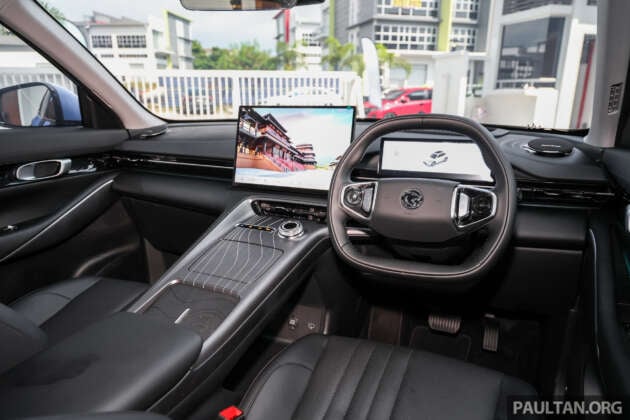
Yesterday, Proton announced that its next model, the eMas 7 PHEV, would be launched in ten days, on February 4. That would put it three weeks after the petrol-electric SUV was opened for booking on January 13, during which the car was also fully revealed without any camouflage.
As a recap, the car carries estimated pricing of between RM110,000 and RM130,000, with three variants – Prime, Premium and Premium+ – set to be offered. The first 5,000 people to book their car (and paying RM99 for the privilege) will receive a RM500 rebate on their booking fee.
Obviously, the eMas 7 PHEV is a twin of a Geely model, in this case the Starray EM-i. While Malaysia has led the way by being the first market outside China to debut the EX5 (eMas 7) and EX2 (eMas 5), we’re lagging behind slightly this time around, getting the car behind a number of key Oceania and ASEAN markets.
We are also in line with other countries when it comes to specs, missing out on the latest powertrain updates for the Chinese-market Galaxy Starship 7 for the 2026 model year. That doesn’t mean that the eMas 7 PHEV is in any way dated, utilising a similarly cutting-edge powertrain as the likes of the Chery Tiggo 7 and 8 PHEV and Jaecoo J7 PHEV.
That means the front electric motor is the predominant force driving the car, producing 218 PS (160 kW) and 262 Nm of torque – same power but less torque than the motor in the eMas 7 EV. This is integrated into the single-speed dedicated hybrid transmission (DHT) that combines 11 components into a single assembly.
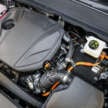
Helping to juice the motor is a 1.5 litre BHE15-DFN naturally-aspirated, port-injected four-cylinder engine, related to the BHE15-CFN mill in the Saga but with single instead of dual variable valve timing, a more efficient exhaust gas recirculation (EGR) system and full-time Atkinson cycle operation, as its priority is on efficient electricity production rather than higher outputs.
This is also why the engine has been made simpler and lighter, and while it does make less as a result – 99 PS (73 kW) and 125 Nm – it also results in a thermal efficiency of 46.5% which, until recently, was a world record. While the four-pot is primarily used to top up the battery when it is running low, it can also clutch in to drive the car at higher speeds, contributing to a nicely equal total system output of 262 PS and 262 Nm.
Speaking of which, the battery is a smaller version of the Aegis short blade LFP unit used in the eMas 7 EV. The Prime and Premium models receive an 18.4 kWh pack that enables a pure electric range of 83 km on the WLTP cycle; with a 51 litre fuel tank, the total range is 943 km. With support for up to 30 kW of DC fast charging, topping up this battery from 30 to 80% will take less than 20 minutes.
Unlike in other global markets, the Premium+ gains the 29.8 kWh battery only recently introduced on China’s 2026 Galaxy Starship 7. This enables an impressive 146 km of EV range and a total range of 996 km. It will also charge more quickly, with a 60 kW DC charger able to bring the battery from 30 to 80% in under 16 minutes. Fuel consumption is rated – oddly, on the old NEDC cycle – at 4.4 litres per 100 km on the Prime and Premium and 4.3 litres per 100 km on the Premium+.
Not long to go now until the launch of Proton’s first plug-in hybrid. Are you excited?
































































AD: Drive the Proton model of your dreams. Submit your details and Proton PJ will get in touch with you.
Looking to sell your car? Sell it with Carro.













buyers get two powertrains in one car so it is reasonable for it to be priced slightly higher.
Everything looks nice except Proton badge. Sorry, I have a very bad experience for my first car- Proton Iswara Aeroback. The way the service manager served csutomer really like you better do not come here so that I have less work to do!