
Remember the open market value (OMV) excise duty revision quandary that crops up every year end, threatening price hikes for CKD locally assembled cars and motorcycles if the government doesn’t give yet another deferment? We’re here again, in the final month of 2025 and with no update in sight. The deferment expires in January 2026.
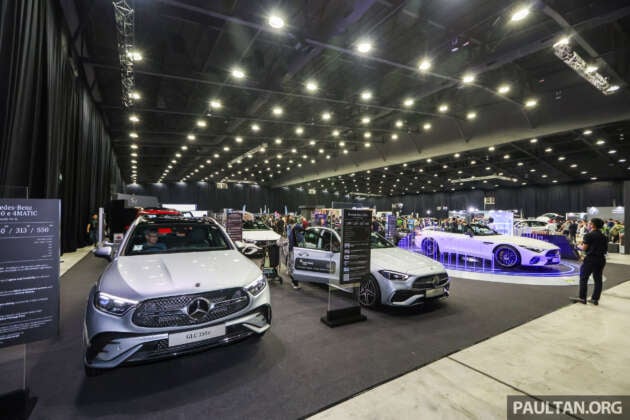
At yesterday’s launch of the Mercedes-Benz GLC 200, we asked Mercedes-Benz Malaysia (MBM) if prices of their CKD cars will shoot up come January 1, 2026, and they flatly said that they have no updates on the matter.
“We’re anxiously waiting for it. Once we have the confirmation, we’ll share it. You’ll see it (price change) from January 1 if there has been any communications. For now, what you see is what you’ll get,” Nadzir bin Ab Razak, MBM’s head of product management and planning said. By the way, the company has prepared a new price list based on changes to the OMV policy, as they have done for a few years now.
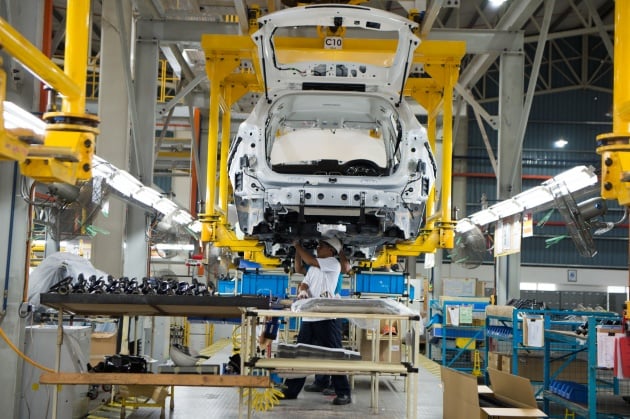
MBM is among the OEMs that have local assembly operations in Malaysia, and if they are still in the dark, we can assume that other carmakers too are yet to hear from the government about another deferment, or better yet, a permanent solution to avoid a déjà vu every December.
When announcing that the auto industry secured a one-year deferment for 2025, Malaysian Automotive Association (MAA) president Mohd Shamsor Mohd Zain said in January that the effect of OMV/402 will be an average price increase of between 10% to 30% for CKD cars, which would lead to lower sales and volume, affecting carmakers and suppliers negatively.
“We are very concerned. Based on our understanding right now the 402 will be implemented by January 2026. If that really happens, there will be an average price increase of between 10% to 30% for CKD cars.
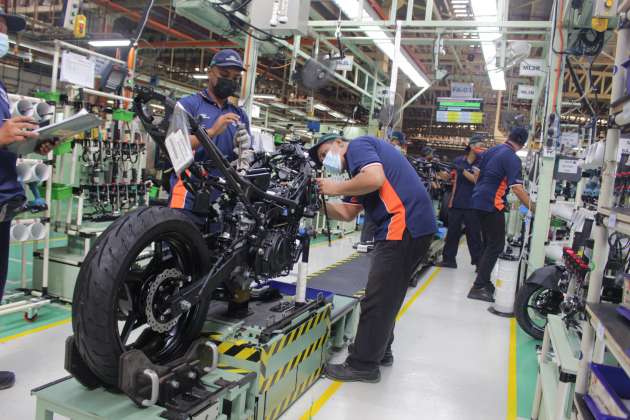
“If that (OMV revision) happens, there will be a lot of spiral down effects for the future years, in terms of lower sales, lower volume, especially for CKDs. It will also have an impact on our local industry, especially our suppliers. There’s a lot of after effects that we’re concerned about,” Shamsor said then, before Malaysia Automotive Component Parts Manufacturers (MACPMA) and Motorcycle and Scooter Assemblers and Distributors Association of Malaysia (MASAAM) weighed in.
What’s this OMV/402 issue all about again? Here’s an explainer on the bullet we’ve been dodging for years, and how we got here. The controversial ‘402’ – gazetted on the last day of 2019 – stipulated a new methodology of calculating a CKD vehicle’s OMV, which influences how much tax is to be paid and therefore, its selling price. OMV is defined as the final market value of a CKD vehicle ex-factory, before the government imposes excise duties on it.
It’s primarily made up of the cost of the CKD pack, cost of manufacturing and components as well as assembly and administration charges. Note that fully-imported (CBU) vehicles use a different system – prices for these are based on Cost, Insurance and Freight (CIF), on which import and excise duties are imposed.

The PH-era regulations set that in calculating OMV, one must take into account not just the profit and general expenses incurred or accounted in the manufacture of a vehicle, but also of its sale. It was this ‘sale’ clause that got industry players up in arms, because it involved areas such as engineering, development work, art work, design work, plan and sketch, royalty payments and license fees (patent, trademark, copyright). Think of it as ‘factory costs’ plus ‘office costs’.
The regulations were supposed to come into force in 2020, but 22 days into that pandemic year, MAA announced that the finance ministry had deferred implementation to 2021. By end-2020, it was deferred again, and MAA appealed to the government in 2022 for continued deferment, which was successful – a two-year deferment was granted, until December 31, 2024. The latest deferment is until December 31, 2025.
As you can imagine, this uncertainty isn’t good for a company’s planning, forecasting and operations. Without clarity, investments will also be hampered – no one wants to invest in local production and ‘live on the edge’ every December hoping for the best. No exaggeration here – the second deferment was announced just two days before 2021 ended!
If prices of CKD cars do go up by as much as 30%, perhaps OEMs will not bother with the hassle of local production and just bring in CBU imports – this would be a loss for the industry and country. Yes, the government would collect more taxes with the revised OMV in the short term, but if higher prices damage sales volume (all-time high in 2024, we have momentum), production and eventually job opportunities for the rakyat, it could be an example of being penny-wise but pound-foolish.
Perhaps the subsequent administrations after Pakatan Harapan do see the logic behind the auto industry’s argument, hence the constant stays of execution, but kicking the can down the road via annual deferments surely isn’t the way to go.
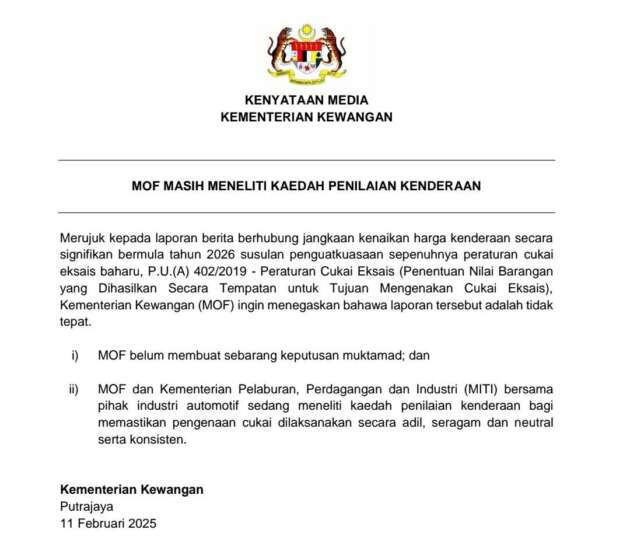
Earlier this year, the finance ministry said that “MoF, together with MITI and the automotive industry, is currently reviewing the vehicle valuation method to ensure that the imposition of tax is carried out in a fair, neutral and consistent manner”. Fingers crossed, again.

We also asked MBM president and CEO Amanda Zhang for updates on Malaysia’s move away from ‘Customised Incentives’ to a fixed and fairer incentive system for the automotive industry. It was supposed to have happened in October, and MITI said in September that it was finalising the New Customised Incentive Mechanism.
It’s still in the works. “I’m actually very much involved with a lot of the discussions with the ministries. Right now, we’re in the process of negotiating a free trade agreement between the EU (European Union) and Malaysia, so there are a lot of discussions happening,” Zhang said.
“We enter this market, we have to accept also the set up as it is. In the current system, a lot of the incentives are done based on individual lobby, and I think the Malaysian government has also realised, and are going forward with greater transparency. So, I cannot say fair or unfair as it depends on each OEM’s contribution to the country.
“But going forward, we know that the policies will bring more transparency to the surface, so it really depends on our investment in the country to come to the respective incentives that we can get,” she added.
Looking to sell your car? Sell it with Carro.





































For car that is currently above 400k, then it is ok for the government to charge OMV, but not at 30% car price increase, just 5% would be sufficient. Instead of paying 400k they need to pay additional 20k. People who can afford 400k and above is considered really rich in Malaysia. 20k extra is just a small money.
For car that is 300k-400k, the government should consider cancel it permanently. 400k below is for T20 which is struggling with their live and wants to rewards themselves with a car instead of getting new mistresses or worse having scandals with the sugar babi.
200k and below is the rakyat’s car, do not charge them or you would lose election.
your threshold is too optiistic . T20 who are struggling with life would also struggle to afford even a 200k car let alone 300k car.
Pls implement it so as to clear up resale cars stocks.
Don’t know what the government is thinking. Car price in Malaysia are already overpriced. 10 years ago, Camry and Accord everywhere which selling about 160K. Nowadays, those afford will go German’s instead. Left over, car around 100K
I feel the same way, but then we say it’s overpriced but the road is filled with cars… granted a ton of them are sh**boxes like Peroduas and old beaten up cars, but still.
camry accord selling today at 200k is because of their greedy , why blame gomen
They love to tax us, right? We’ll tax them back when they come begging for votes in the coming GE.
u can vote for politicians who promise to tax less or no tax at all, and then u also get ready for less subsidies or no subsidies at all.